GOVERNANCE AROMATAWAI DASHBOARD [EXAMPLE]

Ngāti Tauira Trust

Prepared by Te Whare Hukahuka – May 2026

  • Tēnā koe. Nau mai haere mai ki te mata o te Aromatawai.

    He papa tirohanga tēnei e whakarāpopoto ana i ngā kitenga me ngā taunaki kua kohia mai i ngā kōrero me te poari, hei whakapai ake i ngā ahuatanga huhua o ngā mahi a te poari.

    Welcome to this Governance Aromatawai dashboard example.

    Below you will see the components of the dashboard and how we present it to make it easy for a board to see how its governance is doing, the critical areas to work on and the top recommendations for the upcoming seasons.

  • The three main actions to take in when viewing this dashboard are:

    1️⃣ Scroll down through the sections of the dashboard

    2️⃣ Expand each section to dive deeper into the detail – by clicking the ▼ buttons.

    3️⃣ Zoom the text size in or out by going to your browser settings and changing the text or Zoom size.

Shay Wright
Te Rarawa, Te Māhurehure (Ngāpuhi), Ngāruahine

Pou Tokomanawa  |  Facilitator & Executive Director, Te Whare Hukahuka

shay@twh.co.nz     +64 27 523 1560

This Governance Aromatawai dashboard sets out:

SUMMARY
Snapshot of your governance

RECOMMENDATIONS
Our top ten recommendations

DEEP DIVE
Unpacking each dimension

DOCUMENT REVIEW
Checklist & full review of five docs
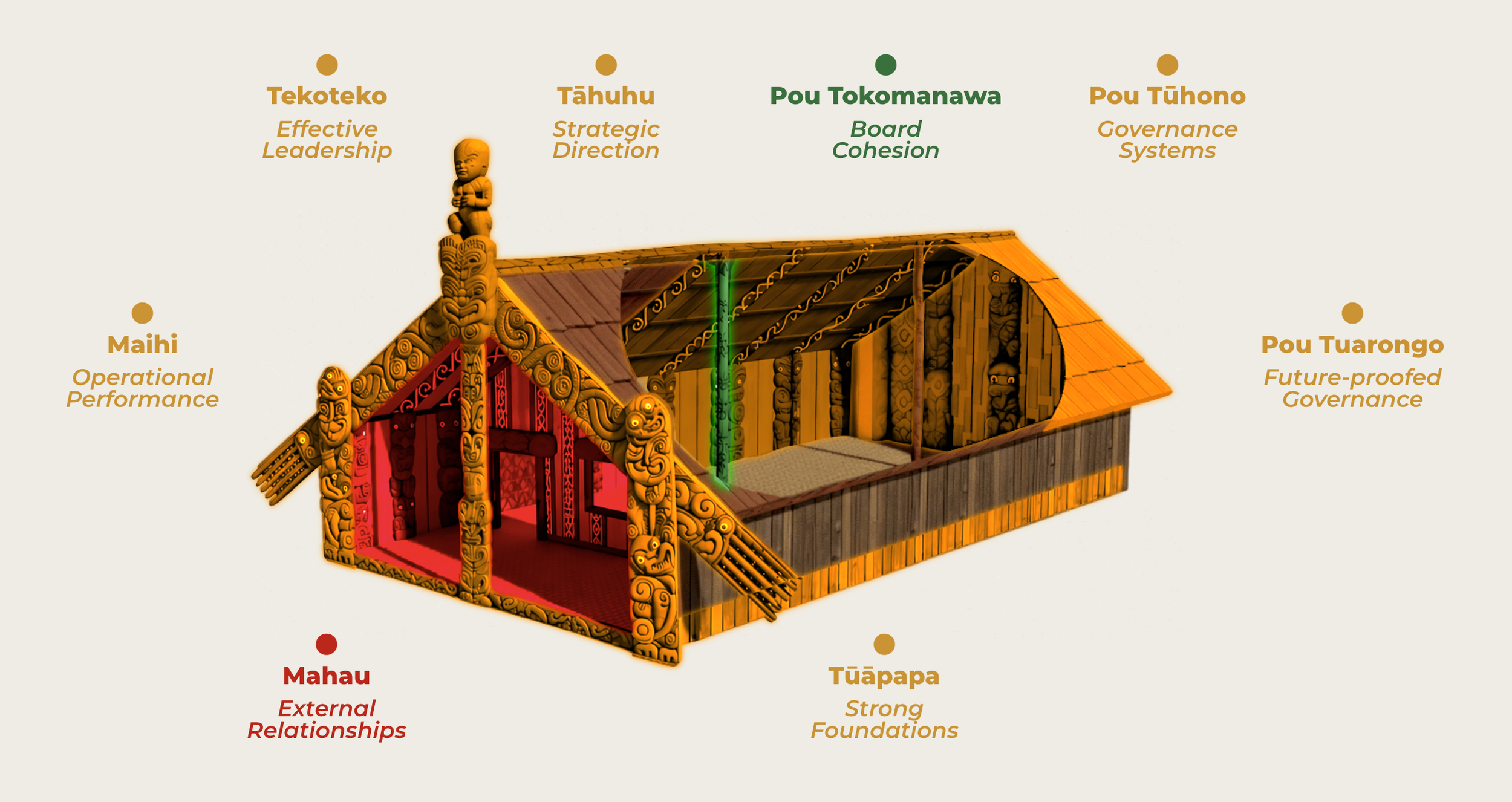

Te Āhua o te Whare | Visual Snapshot

Governance Aromatawai – Ngāti Tauira Trust

Our Whare Tupuna are alive with meaning and mātauranga. The Whare Tupuna governance framework looks at your governance across eight dimensions of Mana – reflecting that governance is more than oversight and compliance – it stewards the mana of the kaupapa and the organisation.

The eight dimensions of the Whare Tupuna are set out below. Each is colour coded to its overall assessment rating. Click on each dimension to see more information about it.

The Whare Tupuna — the eight dimensions of governance mana.

Te Tukanga Aromatawai  |  The Assessment Process

This Aromatawai is a kaupapa-Māori governance assessment that clarifies for your board what is working, what is not, and what to do next to elevate the mana and effectiveness of your board.

It draws on hundreds of data points and perspectives – assessing not just your governance structures and processes, but also the relationships, the leadership dynamics, cultural integration and lived experience of your board members.

We hope this visual dashboard helps your board to easily navigate these key messages to strengthen your governance.

Te Tirohanga Whānui  |  Governance Snapshot

Your board is building strongly – and the structure is almost ready to catch up to the mahi.

Strengths
  • Kaupapa commitment is universal and genuinely held across the board
  • Organisational credibility has lifted measurably in recent reporting
  • Board pack quality is substantially stronger than 12 months ago
  • Financial oversight and reporting is a real strength
  • A direct, robust discussion culture is present, supported by IOD directorship training
  • The board has named most of its own gaps during this aromatawai – the self-awareness is already in the room
Areas for attention
  • Role clarity across Chair, Manager delegations, and Board Secretary needs a coordinated refresh
  • Financial sustainability and income diversification carry real strategic risk that warrants board-level attention
  • Kaupapa frameworks (Tika-Pono-Aroha, kaumātua function) are present but thinly operationalised
Red flags
  • No KPI framework or governance dashboard – the single largest governance gap
  • Marae and iwi member voice does not yet reach the board through any structural mechanism
  • The Manager-board accountability approach needs to be redesigned – rather than relationship repair
  • Succession and wider-board composition is an open question without a current plan
RF #1Tikanga integrity compressed in board settings
Tūāpapa – Strong Foundations
Repeated signals that karakia and mihi are time-compressed rather than given their weight, and that the kaupapa rituals around the board hui have thinned over time.
RF #2Implicit whānau-on-staff and dual-role tikanga is not yet held by an explicit process
Tūāpapa – Strong Foundations
Several whānau-overlap relationships exist (see Rec #10). The tikanga for how these are surfaced, transparently held, and managed at the board table has not been written down.
RF #3Skills gap matrix is not in place
Tekoteko – Effective Leadership
Without a structured view of what skills the board has and needs, recruitment and wider-board succession decisions are guesswork.
RF #4Kaumātua / tikanga advisory function is absent
Tekoteko – Effective Leadership
There is no structural support at the leadership layer for kaupapa framework counsel, energetic centring of meetings, or tikanga integrity oversight.
RF #5Meeting structure not fully involving the Manager
Pou Tokomanawa – Board Cohesion
The Manager only attends the first part of board meetings and then the board has its own independent conversations. This means both sides lack each other's perspective.
RF #6No clear systems to track KPIs at board level
Pou Tūhono – Governance Systems
The board does not yet have an agreed governance instrument that translates strategic priorities into measurable indicators tracked over time.
RF #7No governance dashboard
Pou Tūhono – Governance Systems
Cultural, clinical, financial, operational, and stakeholder data are not yet integrated into a single visual the board can scan in one read.
RF #8Action accountability appears to be loosely held
Pou Tūhono – Governance Systems
Decisions and actions are recorded but the cadence of follow-through and the process for chasing them between meetings is not yet visible in the system.
RF #9Single-contract dependence is a real financial sustainability risk
Tāhuhu – Strategic Direction
The bulk of revenue currently comes through one commissioning relationship. Income diversification logic is not yet documented in the strategy, and this warrants a dedicated board-level conversation rather than sitting under operational risk.
RF #10Strategy is directional rather than executable
Tāhuhu – Strategic Direction
SMART goals are not yet articulated against priorities, time horizons are not differentiated (5/10/20 years), and accountability and ownership are not assigned per goal.
RF #11Performance review cadence unresolved
Maihi – Operational Performance
Quarterly versus annual is not landed. The current pattern is experienced as containment by one side and as drift by the other.
RF #12Differing perspectives around the level of information the board needs regarding contract performance
Maihi – Operational Performance
The board and the Manager have not yet reached a shared view on what the board needs to see, in what depth, and at what cadence – leaving both sides asking for different things.
RF #13Differing perspectives around Manager KPI interpretation and performance
Maihi – Operational Performance
Without an agreed KPI framework (Rec #1), each side reads performance through its own lens – growth and MOUs from one direction, outcomes and impact from the other.
RF #14Challenges with the Manager-board relationship
Maihi – Operational Performance
The kaupapa for the relationship is strong on both sides; the structural approach for it is under-built. Repeated signals that the current design is producing dynamics neither side wants.
RF #15No board succession plans
Pou Tuarongo – Future-proofed Governance
Beyond the Manager and Chair, there is no proactive process for identifying or developing future board members.
RF #16No clearly written board induction processes for incoming trustees
Pou Tuarongo – Future-proofed Governance
Section 12 covers the materials new trustees receive but the broader induction journey beyond the first meeting is not formalised.
RF #17Chair succession not planned
Pou Tuarongo – Future-proofed Governance
This role is critical, carries key person risk and feedback was that no current board member has the capacity to take it on.
RF #18Single-contract dependence increases the risk to your future
Pou Tuarongo – Future-proofed Governance
One commissioning relationship currently underwrites the bulk of revenue. Any future-proofing failure compounds because the runway is concentrated.
RF #19Marae and iwi members have no structural voice into board decisions
Mahau – External Relationships
The people the kaupapa exists to serve currently reach the board only through staff. This is a kaupapa integrity issue, not a process issue.
RF #20External relationships sit primarily with the Manager
Mahau – External Relationships
Marae, Council, other iwi, Government agencies and other governance-level relationships are concentrated in one role. If anything happens to that relationship, the institutional partnerships are exposed.

Kupu Tohutohu  |  Top Ten Recommendations

Click any recommendation below to expand the full detail. We have also noted the governance dimension that it relates to.

1
Have the Manager stay for the entire board meeting
Rec #1First 90 daysPou Tokomanawa – Board Cohesion
Purpose

Restore Manager presence in the full board meeting. The current pattern – Manager attending only briefly – produces a -board accountability dynamic neither side wants. Full presence builds shared context, reduces the need for downstream catch-up, and lets the board's strategic discussion stay informed by operational reality.

Context

Repeated signals across the engagement that the board has its own independent conversations once the Manager leaves the room, and that both sides feel they are missing each other's perspective. The board's cohesion as a group is genuinely strong (Pou Tokomanawa is green); this is about extending that cohesion to include the Manager at the right moments rather than fixing how the board functions internally.

Practical ideas
  • Default to Manager attending the full board meeting, with a clearly agreed handful of in-camera moments where the Manager is excused.
  • Agree explicit principles for which agenda items always include the Manager (strategy, accountability, kaupapa, anything the Manager is materially accountable for).
  • Build a brief board-only kōrero into the agenda structure if needed – bookended cleanly so it does not become the de facto main meeting.
  • Pair this with an explicit Chair–Manager 1-on-1 cadence outside meetings so the relational layer has its own process.
Cost of inaction
  • The dynamic neither side wants keeps reproducing itself.
  • The board's strategic conversation continues to be informed by partial Manager context.
  • The Manager continues to receive board outcomes second-hand, weakening alignment between governance decisions and operational delivery.
2
Clarify and formalise the Board Secretary position description and processes
Rec #2First 90 daysTekoteko – Effective Leadership
Purpose

Resolve the structural ambiguity around the Board Secretary role. A formal position description, a clear reporting line, and an agreed process for filling the role would lift the role from contested-and-implied to defined-and-accountable.

Context

Across the document reviews and interviews the Board Secretary role was repeatedly flagged as under-specified – the manual references the role only briefly, the reporting line is unclear (independent of the Manager? sitting under the Manager?), and there is no agreed recruitment process. Several trustees raised differing models during this engagement.

Practical ideas
  • Draft a formal Board Secretary position description covering meeting support, minute-taking, compliance filings, records management, and trustee induction support.
  • Resolve the reporting line – agree whether the role reports independently to the board, sits under the Manager, or operates as a hybrid.
  • Decide whether a formal recruitment process is needed (open advertisement, position re-tendered) or whether the role is filled by appointment from the existing pool.
  • Update the Governance Manual to reflect the agreed shape of the role.
Cost of inaction
  • The role stays structurally ambiguous; the next dispute over its scope or accountabilities has no strucural strength to lean on.
  • Compliance and records discipline depends on an under-specified role, which is a quiet operational risk.
  • Wider-board induction quality varies depending on who is currently holding the role.
3
Ensure a well populated Maramataka / Annual Calendar
Rec #3First 90 daysPou Tūhono – Governance Systems
Purpose

Build out a Maramataka / Annual Calendar that maps the key governance milestones across the year – strategy review, AGM, audit cycle, KPI review checkpoints, kaupapa moments. Gives the board a single shared rhythm to plan against and reduces the year-end scramble.

Context

A maramataka has been begun (a real strength) but is not yet fully populated. Survey signal: an Annual Calendar was the most-named governance support that trustees said they were missing. Document reviews flagged the absence of a visible policy review schedule and the lack of a mapped year-of-governance rhythm.

Practical ideas
  • Map the full year of governance commitments – strategy, financial, audit, kaupapa milestones, statutory dates.
  • Layer the policy review cycle into the maramataka (which policies refresh in which quarter).
  • Surface the KPI dashboard refresh cadence (Rec
  • Make the maramataka visible to the wider organisation, not just the board, so operational rhythms can sync to it.
Cost of inaction
  • The board continues to react to milestones rather than plan against them.
  • Policy review continues to be ad hoc.
  • The KPI framework when built (Rec #1) has nowhere structural to land for refresh cadence.
4
Translate the strategic vision into SMART goals with time horizons
Rec #4First 90 daysTāhuhu – Strategic Direction
Purpose

Translate the kaupapa vision and strategic priorities into time-bound, owned, measurable goals. Close the gap between what the board agrees on (the kaupapa) and what the board is executing against (the strategy). Where Rec #1 is about building the measurement framework, Rec #6 is about building the plan that the framework is measuring.

Context

Document reviews flagged multiple red items on SMART goals, accountability, monitoring, resourcing and sequencing. There appears to be a phased growth plan internal to the executive team that has not yet been formally adopted by the board.

Practical ideas
  • Translate the strategic priorities into SMART goals for the next 12 months.
  • Add 5/10/20-year horizons to differentiate near-term execution from longer-term direction.
  • Assign accountability and ownership per goal – board lead, Manager lead, or joint.
  • Add a plan-on-a-page visual overview suitable for staff, whānau, marae, partners, and funders.
  • Document the income-diversification logic explicitly, including the sequencing (credibility → tender profile → diversification).
  • Make sure that there is Board and Manager agreement around the logic and sequencing of the plan as it is built.
Cost of inaction
  • Strategy continues to be experienced as 'here and there' rather than sequenced.
  • Kaupapa alignment continues to mask strategic drift.
  • The phased growth logic stays in executive heads rather than being adopted by the board.
  • Income diversification – a board-level outcome – stays structurally unsupported because the underlying plan is unwritten.
5
Build a KPI framework and governance dashboard
Rec #5First 6 monthsMaihi – Operational Performance
Purpose

Establish a shared instrument between the board and the Manager for what success looks like, grounded in Tika-Pono-Aroha. A KPI framework unlocks accountability, dashboard adoption, and a more developmental performance-review cadence.

Context

This was the strongest governance gap raised across the engagement. It came up independently in interviews, scored lowest on the survey item asking whether milestones are clear, and was flagged red across multiple document reviews on SMART goals, measurement, accountability and monitoring.

Practical ideas
  • Translate the strategic priorities into SMART measures across categories such as cultural, clinical, financial, operational, and stakeholder outcomes.
  • Use Tika-Pono-Aroha as a weighting frame so the dashboard carries the kaupapa lens, not just operational data.
  • Visualise as a traffic-light governance dashboard refreshed monthly, with a one-line narrative under each indicator.
  • Identify the specific indicators and whether information can come from existing systems (e.g. social contract data, Xero outputs, management reporting) or requires new data collection.
Cost of inaction
  • The board has no instrument to hold the Manager accountable other than narrative.
  • The strategic plan remains aspirational without translation into operational reality.
  • Performance review continues to be experienced as containment rather than development.
  • The Manager is asked for measures the board has not been clear on – the relationship strains both ways.
6
Coordinated refresh of role clarity and delegated authorities
Rec #6First 6 monthsTekoteko – Effective Leadership
Purpose

Move the board from personal-discipline-based governance to architecture-based governance – written roles, written delegations, written succession. This brings clarity to who is authorised to decide what, on whose behalf.

Context

There were five amber or red items noted in the Governance Manual and Trust Deed reviews that all concern authority and delegation. This was also raised in the surveys and interviews as an issue. Worth resolving as one coordinated workstream rather than five separate policy edits.

Practical ideas
  • Consolidate the Chairperson position description into a single section.
  • Establish a Chairperson delegated-authorities schedule covering urgent decisions, media, and between-meeting authority.
  • Establish a Manager delegation schedule with spending and contract thresholds and what must come back to the board.
  • Define the Board Secretary position description and resolve the reporting line.
  • Establish a board skills gap matrix to guide composition and wider-board succession.
Cost of inaction
  • The Chair operates without a formal mandate for urgent decisions or media response.
  • Manager delegations stay implied, which keeps accountability narrative-based rather than threshold-based.
  • The Board Secretary role stays contested and structurally ambiguous.
  • Wider-board recruitment stays guesswork without a skills matrix.
  • Chair succession stays unplanned – a single-point-of-failure risk.
7
Redesign the Manager-board accountability approach
Rec #7First 6 monthsMaihi – Operational Performance
Purpose

Strengthen the structural design of the Manager-board relationship so the approach supports accountability and development rather than producing avoidance dynamics on either side.

Context

Several signals across the engagement suggest the current design is producing patterns neither side wants – a Manager performance review experienced as surveillance, a meeting structure that minimises the Manager's time in the room, and limited shared time on accountability and strategy. The kaupapa for the relationship is strong on both sides; the architecture for it appears under-built.

Practical ideas
  • Move Manager performance review from quarterly review to annual review supported by a quarterly data dashboard (Rec #1).
  • Restore Manager presence in full board meetings, or at minimum in strategic and accountability items.
  • Establish a monthly Chair-Manager 1-on-1 with a published agenda and recorded decisions.
  • Surface and resolve the philosophical KPI mismatch (growth and MOUs vs outcomes and impact) within the KPI framework (Rec #1) so the dashboard lands as a negotiated artefact.
Cost of inaction
  • The current pattern keeps looping. Each performance review reinforces the existing posture.
  • The Manager's strengths remain insufficiently visible to the board because of limited structured time together.
  • External relationship risk stays concentrated on the Manager because no architecture redistributes it (see Rec #8).
  • The relationship continues to be experienced as stressed by both sides.
8
Plan board composition and succession – deputy chair, rotation tikanga, wider-board pipeline
Rec #8First 6 monthsPou Tuarongo – Future-proofed Governance
Purpose

Move from no planned board composition to active succession planning. Address three specific structural gaps: no chair successor, no deputy chair, seventh seat unfilled. Open a rangatahi pipeline.

Context

There is currently no chair successor, no deputy chair, and an unfilled seventh seat. The Governance Manual review confirms the skills matrix is absent and wider-board succession is absent. Personality composition signal: the board sits heavily on Thinking-Judging types and lacks Sensing-Feeling balance.

Practical ideas
  • Reinstate a deputy chair – lowest-friction, highest-impact move.
  • Run a skills gap assessment (from Rec #2) and recruit the seventh seat against identified gaps.
  • Hold a tikanga-led conversation about long-tenured trustee rotation – honouring service while securing whakapapa continuity.
  • Commit to a rangatahi pipeline (e.g. via Ka Eke Poutama).
  • Privilege Sensing-Feeling profiles (ISFJ / INFJ / ESFJ) in candidate selection to balance the existing board composition.
Cost of inaction
  • Chair succession unplanned remains a single-point-of-failure risk.
  • The seventh seat sits empty; board capacity stays at 6 of 7.
  • Composition stays thin on Sensing-Feeling profiles – limited relational-nuance and maintenance-focused voices.
  • The rangatahi pipeline opportunity is missed or delayed.
9
Build a board-led mana whenua and institutional partnership strategy
Rec #9Next 12 monthsMahau – External Relationships
Purpose

Shift institutional partnership-holding from sole-Manager to board-led where appropriate – marae, hapū, other iwi, Council, Governance agencies, at governance level, data infrastructure partners. Both sides agree the board should lead at governance level while the Manager manages at operations level; this rec makes the agreement operational.

Context

Mahau was the lowest-scoring dimension on the survey, and partnerships scored low within it. Document reviews flagged engagement with affiliated groups as amber. Marae and iwi relationships are newly contractually required and not yet in place.

Practical ideas
  • Stand up a marae relationship plan aligned to new contract expectations.
  • Allocate specific board members as partnership leads, leveraging existing relationships as starting points.
  • Design a board-dinner or formal-hui model for partnership development.
  • Reconsider the partnerships KPI – to balance a focus on purely MOU count with actual relationship quality (linked to Rec #1).
Cost of inaction
  • Marae obligation (newly contractual) remains unmet.
  • Board-to-board partnerships stay underdeveloped.
  • Partnership measurement continues to misfit, straining the Manager-board relationship.
  • External relationship risk stays concentrated on the Manager.
10
Establish a marae and iwi member voice mechanism into board decision-making
Rec #10Next 12 monthsMahau – External Relationships
Purpose

Having a structural mechanism for marae and iwi members – the people the organisation exists to serve – to provide thinking directly to the board will mean the marae and iwi member voice is more directly present in strategic planning, rather than only being heard through staff.

Context

Stakeholder involvement was the lowest scoring of all survey questions and this was reinforced in all five interviews. Document reviews cannot see this because the documents do not structurally include marae.

Practical ideas
  • Adopt a proposed marae rep forum – one representative per marae (supported-living house) coming together as a board sub-committee, alongside any iwi member board representative.
  • Have a standing board agenda item: 'Feedback from the marae rep forum.'
  • Have a formal strategic planning day (annual wānanga or equivalent) where marae voice directly feeds in.
  • Consider piloting with two whare first before scaling.
Cost of inaction
  • A misalignment between process and kaupapa intensifies. The organisation exists to serve marae and iwi members; they currently have limited structural voice in its governance.
  • Strategic planning continues to be Manager-and-board only.
  • Staff remain the main relational carrier of the marae connection – a concentrated relational risk that excludes the board.

Kupu Āwhina  |  Additional Recommendations

Additional recommendations from the engagement, sitting alongside the Top Ten. Click any card to expand the full detail.

Operationalise Tika-Pono-Aroha and anchor a kaupapa Māori conceptual framework
Rec #11Next 12 months
Purpose

Convert Tika-Pono-Aroha from a shared value-anchor into an operational decision rubric the board uses at the point of decision. Anchor a kaupapa Māori conceptual framework in the Strategic Plan so the kaupapa the board lives is visible in the kaupapa the organisation publishes.

Context

Values are present and genuinely held; the architecture for living them in actual strategic and operational decisions appears thin. There are repeated signals that Tika-Pono-Aroha sits 'at the back of the mind' rather than functioning as an evaluation framework, and that tikanga practices in board settings (e.g. karakia) are time-compressed.

Practical ideas
  • Convert Tika-Pono-Aroha into an explicit decision rubric – each material decision scored against each component, with a weighting applied.
  • Clarify the relationship between Tika-Pono-Aroha and underlying kaupapa frameworks (e.g. Te Whare Tapa Whā, Pōwhiri Kaupapa, Poutama) – which framework for which purpose.
  • Restore tikanga integrity in board practice – karakia with time and intention, not tick-box; opening and closing mihi given their weight.
  • Strengthen the kaupapa Māori conceptual framework anchor in Strategic Plan v2 (alongside Rec #6).
Cost of inaction
  • Tika-Pono-Aroha remains a values-card rather than a decision tool. The board defaults to intuition under pressure.
  • The KPI philosophy gap (Rec #3, Rec #1) has no kaupapa-level resolution frame.
  • Tikanga practices in board settings drift further toward tokenism.
Restore a kaumātua / tikanga advisory function to the board
Rec #12Next 12 months
Purpose

Restore a kaumātua / tikanga advisory function so the board has structural support for energetic centring of meetings, kaupapa framework counsel, and tikanga integrity oversight. Define the function, separated from the question of which person fills it.

Context

The function has been absent for some time. Several trustees have signalled the absence, particularly around the energetic settling of board hui and the use of kaupapa frameworks. Survey partial signal via 'Values & tikanga' 3.75; 'Access to Trust documents' 3.50 (σ=1.20).

Practical ideas
  • Define the function of the kaumātua role, separated from the question of who will actually fill it. The function covers energetic centring of meetings, kaupapa framework counsel, tikanga integrity oversight, and whanaungatanga holding.
  • Identify candidates by function fit, not by pre-existing relationship – widens the candidate pool.
  • Agree structural placement – advisor, committee member, or board member. Each carries different implications for authority and time.
  • Commit to a timeframe so the function does not stay absent through open-ended exploration.
Cost of inaction
  • Tikanga integrity continues to compress at the board table.
  • A single board member carries the kaupapa-bridge role alone – unsustainable and unfair.
  • No structural resource is available for complex tikanga-led decisions.
  • The board's shift from personal-discipline governance to architecture governance (Rec #2) stays kaupapa-thin.
Make implicit whānau-governance tikanga explicit
Rec #13Next 12 months
Purpose

Make the whānau-governance tikanga the board currently holds implicitly into explicit, written process arond this. Whānau-governance patterns are kaupapa-grounded and not inherently problematic – the absence of an explicit process for surfacing and managing them is the opportunity. Also establish tikanga-based dispute resolution in the Trust Deed.

Context

Several whānau-governance patterns appear to be present, such as the trustee-Secretary whānau connection and the Keita-Bookkeeper whānau relationship. These relationships are kaupapa-grounded; the gap is that there does not appear to be an explicit process for managing the resulting conflicts of interest. Document reviews flag the Trust Deed red on tikanga-based dispute resolution and amber on substantial transactions thresholds. Frame this as making implicit tikanga explicit, not as a prosecution of whānau patterns.

Practical ideas
  • Add tikanga-based dispute resolution to the Trust Deed.
  • Add explicit whānau-on-staff and whānau-on-board tikanga to the governance manual – how transparency is held, when step-asides are required.
  • Publish and maintain a Conflict of Interest register with all dual-role relationships declared.
  • Reset the Conflict of Interest protocol for the personnel committee – partial step-aside (out of specific decision) rather than total step-aside (out of whole committee).
Cost of inaction
  • Implicit whānau patterns remain a reputational risk the board has no formal process to manage.
  • A future dispute has no tikanga-based resolution process – defaulting to secular dispute norms.
  • Unresolved conflict-of-interest patterns accumulate; each new instance adds weight to the existing ambiguity.
  • The personnel committee functions weakly because the current protocol forces total chair step-aside.
Tūāpapa | Strong Foundations Kaupapa foundations are genuinely and widely held; the architecture for operating them has thinned – Tika-Pono-Aroha appears aspirational rather than operative, kaumātua function is absent, tikanga practices risk tokenism in board settings.

Tūāpapa represent the foundations that guide your board's decisions and behaviour – including the kaupapa, values, tikanga, policies and core documents that anchor everything above. They are the load-bearing beliefs that remain over time and shape how your board operates into the future.

Reflects Mana Whenua – mana built from drawing on tūpuna-led guidance that serves the present and will outlast any one board to safeguard the future.

“Whatungarongaro te tangata, toitū te whenua”
People pass on, but the land remains.
Western lens
Foundations are documents to be authored, ratified and audited.
Kaupapa Māori lens
Foundations are living tikanga that shape how decisions are made and how the board carries the kaupapa between sessions.
Your foundations are strongly held – the operating architecture is the work to do.

Kaupapa commitment is universal; the day-to-day ways of operating that kaupapa appear thin.

Strengths
Trust Deed is comprehensive and well-grounded
25 of 33 items green; kaupapa Māori framing is strong; tikanga context is visible throughout.
Kaupapa commitment is universal across the board
Every interview centred kaupapa as the organising principle.
Conflict-of-interest discipline is principled
Repeated signals that members step aside when conflicted.
Areas for attention
Tika-Pono-Aroha not yet operationalised as a decision rubric
Present as a values-anchor; not yet an evaluation framework at the point of decision.
Kaumātua / tikanga advisory function absent
Structural gap affecting the energetic settling of board hui.
Governance Manual delegations implied not explicit
Manager schedule, Chair authorities, Board Secretary reporting line.
Kaupapa Māori framework named in the Strategic Plan but not anchored operationally
RF #1
Tikanga integrity compressed in board settingsRepeated signals that karakia and mihi are time-compressed rather than given their weight, and that the kaupapa rituals around the board hui have thinned over time.
RF #2
Implicit whānau-on-staff and dual-role tikanga is not yet held by an explicit processSeveral whānau-overlap relationships exist (see Rec #10). The tikanga for how these are surfaced, transparently held, and managed at the board table has not been written down.

Recommendations to improve your Tūāpapa

Operationalise Tika-Pono-Aroha and anchor a kaupapa Māori conceptual framework
Rec #11First 6 months
Purpose

Convert Tika-Pono-Aroha from a shared value-anchor into an operational decision rubric the board uses at the point of decision. Anchor a kaupapa Māori conceptual framework in the Strategic Plan so the kaupapa the board lives is visible in the kaupapa the organisation publishes.

Context

Values are present and genuinely held; the architecture for operating them appears thin. There are repeated signals that Tika-Pono-Aroha sits 'at the back of the mind' rather than functioning as an evaluation framework, and that tikanga practices in board settings (e.g. karakia) are time-compressed.

Practical ideas
  • Convert Tika-Pono-Aroha into an explicit decision rubric – each material decision scored against each component, with a weighting applied.
  • Clarify the relationship between Tika-Pono-Aroha and underlying kaupapa frameworks (e.g. Te Whare Tapa Whā, Pōwhiri Kaupapa, Poutama) – which framework for which purpose.
  • Restore tikanga integrity in board practice – karakia with time and intention, not tick-box; opening and closing mihi given their weight.
  • Strengthen the kaupapa Māori conceptual framework anchor in Strategic Plan v2 (alongside Rec #6).
Cost of inaction
  • Tika-Pono-Aroha remains a values-card rather than a decision tool. The board defaults to intuition under pressure.
  • The KPI philosophy gap (Rec #3, Rec #1) has no kaupapa-level resolution frame.
  • Tikanga practices in board settings drift further toward tokenism.
Make implicit whānau-governance tikanga explicit
Rec #13Next 12 months
Purpose

Make the whānau-governance tikanga the board currently holds implicitly into explicit, written approach to guide this. Whānau-governance patterns are kaupapa-grounded and not inherently problematic – the absence of an explicit process for surfacing and managing them is the opportunity. Also establish tikanga-based dispute resolution in the Trust Deed.

Context

Several whānau-governance patterns appear to be present, such as a trustee-Secretary whānau connection; and the Manager-Bookkeeper whānau relationship. These relationships are kaupapa-grounded; the gap is that there does not appear to be an explicit process for managing the resulting conflicts of interest. Document reviews flag the Trust Deed red on tikanga-based dispute resolution and amber on substantial transactions thresholds. Frame this as making implicit tikanga explicit, not as a prosecution of whānau patterns.

Practical ideas
  • Add tikanga-based dispute resolution to the Trust Deed.
  • Add explicit whānau-on-staff and whānau-on-board tikanga to the governance manual – how transparency is held, when step-asides are required.
  • Publish and maintain a Conflict of Interest register with all dual-role relationships declared.
  • Reset the Conflict of Interest protocol for the personnel committee – partial step-aside (out of specific decision) rather than total step-aside (out of whole committee).
Cost of inaction
  • Implicit whānau patterns remain a reputational risk the board has no formal approach to guide this.
  • A future dispute has no tikanga-based resolution process – defaulting to secular dispute norms.
  • Unresolved conflict-of-interest patterns accumulate; each new instance adds weight to the existing ambiguity.
  • The personnel committee functions weakly because the current protocol forces total chair step-aside.
Board Documents – Tūāpapa
Trust Deed / Kawenata
2562
The Ngāti Tauira Trust Deed provides a comprehensive and well-structured governance foundation, grounded in kaupapa Māori and clearly oriented toward community wellbeing. The document is thorough across most core governance areas, with particular strength in its detailed powers, financial procedures, and cultural framing.
25 items complete – Charitable purposes, Trust origin and scope, trustee processes and powers, financial procedures, conflict disclosure, governance-operations separation, amendments, and tikanga framing all well covered
6 items partial – Decision-making thresholds, Board Secretary independence, Chair succession, member register rules, stakeholder engagement, and intergenerational focus are present but not fully specified
2 gaps – Substantial transactions thresholds and tikanga-based dispute resolution are not evident in the deed
Present and well-articulated
The document clearly articulates:
Charitable purposes / kaupapa
Background and origin of the Trust
Geographic scope of the Trust
Clarity of who the beneficial members are
Definitions for key terms
Number of trustees (minimum and maximum)
Trustee appointment processes and terms
Appointment of Chairperson and other key positions
Meeting procedures
Voting and resolution processes
Quorum definition
Trustees’ duties
Trustees’ powers
Trustees’ interest disclosures / Conflicts of Interest processes
Trustee liability and indemnity
Remuneration and reimbursement provision
Financial procedures
AGM requirements
Establishment and use of sub-committees
Powers to delegate
Governance vs operations clarity
Board performance review and removal processes
Trust Deed amendment process
Te Ao Māori / tikanga framing
Collective decision-making recognised
Partial — present but under-specified
Several further governance mechanics are present in the Trust Deed but are not fully specified:
Decision-making thresholds (simple majority vs special resolution vs unanimous consent)
Provision for an independent Board Secretary
Chair succession and term limits
Rules around register of members / beneficiaries
Engagement with affiliated groups or named stakeholders
Intergenerational / legacy focus
Not evident
Several contemporary governance controls typically expected in a Trust Deed are not evident in this document, including: Note: These may exist in separate policies or be informally practised, but are not specified in the Trust Deed.
Substantial transactions thresholds and processes
Tikanga-based dispute resolution
Other reasoning notes

My reasoning on the close calls:

Conflicts of Interest – green (not amber): The deed has a clear and specific disclosure and abstention process. Clause 10.3 requires any Trustee with a direct or indirect interest in a matter to disclose the nature and extent of that interest, and to abstain from any deliberations on the matter. That’s a substantive COI mechanism, not just a general reference to managing conflicts.

Governance Manual / Board Charter
962
This is a well-structured governance manual covering 26 sections across board operations, financial management, risk, communications, and strategic planning. The manual is strong on compliance policies and board processes – conflicts of interest, financial controls, risk management, and meeting procedures are all substantively addressed. The main opportunities sit in role clarity, where the Chairperson, Board Secretary, and Manager roles would benefit from more specific position descriptions and delegated authorities.
9 items complete – 9 of 17 items are complete – risk management, conflicts of interest, financial management, board member expectations, committee governance, communications, performance assessment, induction, and strategic planning are all well covered
6 items partial – 6 items are incomplete – health and safety, expense reimbursement, Chairperson and Board Secretary descriptions, Manager delegated authorities, and succession planning are partially addressed but not fully developed
2 gaps – 2 items are not evident – Chairperson delegated authorities and a skills gap assessment process are not in the document
For compliance
Five core compliance policies. Most are well addressed, with dedicated sections for risk management, conflicts of interest, and financial management.
Risk Management policySection 22 is a dedicated risk management policy. It sets out annual development of a risk management plan by the Manager, regular reporting to the board on risks, provision for interim reviews when significant changes occur, and a requirement for adequate insurance cover. Section 22.4 also covers trustee indemnities and insurance.
Conflicts of Interest policySection 18 is a dedicated conflicts of interest policy. It defines what constitutes a conflict and a pecuniary interest with specific examples, requires a register of conflicts declared at meetings, and sets out management procedures – including requiring the conflicted member to leave the meeting room. Section 18.4 also addresses contracting board members, capping this at $25,000 per annum.
Financial Management policySections 23 and 24 together form a substantive financial management framework. Section 23 covers budget preparation, revenue projections, operating expenditure, capital requirements, and cash flow. Section 24 covers financial controls, compliance with accounting principles and the Charitable Trust Act 2019, variance reporting at the 5% threshold, investment of surplus funds, fraud prevention, and the external audit process. The Finance & Audit Committee described in section 7.11 adds another layer of oversight.
Health & Safety policyHealth and safety appears only in section 14 (Legal Compliance), where “Occupational Health and Safety” is listed as one of several pieces of legislation the board has obligations under. There is no standalone H&S policy, no description of how the board oversees H&S risk, and no reference to a separate H&S policy held elsewhere. The topic is addressed in a single line within a broader compliance section.
Reimbursement of expenses policySection 16 covers board remuneration in detail – meeting fees are specified (Chairperson $750, other trustees $500, committee members $300), consumables have a sign-out process, non-consumable assets require Chairperson approval, koha is at the member’s discretion, and mileage is explicitly excluded. However, reimbursement of out-of-pocket expenses is limited to a single line in section 16.3: “Reimburse members for reasonable expenses incurred during Board business.” There is no detail on what expenses are covered, how claims are submitted, or who approves them beyond the Chairperson’s general role.
For role clarity
Seven items covering position descriptions, delegated authorities, committee terms of reference, and communications. The manual covers communications and committee governance well but has gaps in role-specific descriptions and delegation schedules.
Board member position descriptionSection 4 (Trustee Code of Conduct & Ethics) sets out 13 specific expectations of board members. These cover acting honestly and in good faith, legal compliance, conflicts of interest, confidentiality, public representation, client care, loyalty to the Trust’s values, respect for staff, active participation in discussion, collective decision-making, self-monitoring, and professional development. A board member reading this section would understand what is expected of them.
Terms of Reference for board sub-committeesSection 7 provides a comprehensive committee framework. Sections 7.11 and 7.12 describe the two principal standing committees – Finance & Audit and Personnel – covering their composition, functions, quorum requirements, staff involvement, and confidentiality expectations. The general committee provisions (sections 7.1–7.10) cover how committees are established, their authority boundaries, reporting requirements, co-opting of members, and the principle that committee decisions are not binding on the board.
Media Statements & Communications policySection 17 is a dedicated communications policy covering spokesperson authority (Chairperson), media management (enquiries go to Manager first), external stakeholder communication, media training for board members and senior managers, and an annual communications strategy developed by the Manager. It also addresses public comments and the respective roles of the Chair and Manager in media responses.
Chairperson position descriptionThe Chair’s role is referenced across multiple sections – leading meetings and setting the tone for debate (section 8.2), acting as the formal link between board and Manager (section 11.3), making public statements to media (section 17.3), approving use of non-consumable assets (section 16.6), and overseeing induction meetings (section 12.4). However, these references are spread across the manual with no consolidated position description. There is no standalone section that brings together the Chair’s responsibilities, accountability, expected skills, or time commitment.
Board Secretary position descriptionThe Board Secretary is mentioned once in section 5.8, which states that “Successful Trustees will be provided with copies of the necessary documents by the Secretary of the Board.” There is no description of the Secretary’s broader responsibilities – meeting support, minute-taking, compliance filings, or records management – and no dedicated position description.
Manager / CE delegated authoritiesSection 8.2 establishes the general delegation principle: the board delegates to the Manager the role of developing and implementing policies, and “all Board authority delegated to staff is delegated through the Manager.” The Manager’s responsibilities appear across multiple sections – financial controls (section 24), risk management (section 22), reporting (section 19), communications (section 17), and induction (section 12). However, there is no delegation schedule or policy setting out specific financial thresholds, spending authorities, or the limits of the Manager’s independent decision-making power.
Chairperson delegated authoritiesThe manual does not include any statement of what the Chairperson can decide without full board approval. There are no financial thresholds, emergency decision-making provisions, or defined limits on the Chair’s authority to act between meetings.
For continuity
Five items covering how the board sustains itself over time. Induction, board performance assessment, and strategic planning are all well developed. Succession planning covers the Manager and Chair but not the wider board.
Board performance assessment policySection 13 describes a clear process: the Personnel Committee initiates an annual evaluation of the board’s performance immediately after the AGM, can commission an independent evaluation subject to budget, ensures feedback from interested parties on reputation, leadership, financial management, and effectiveness, and identifies recommendations for improvement. An evaluation template is referenced in the appendices.
Board member induction process policySection 12 is a dedicated induction policy. It lists eight specific induction materials new trustees receive – including the governance manual, trust deed, strategic and business plans, latest audited financials, risk management plan, recent board minutes, and a code of behaviour document to sign. Section 12.4 describes the induction meeting: new trustees meet the Chair for a governance overview, the Manager for an operational overview, and receive a guided tour of the Trust’s facilities.
Strategic Direction & Planning policySection 20 describes the board’s strategic planning process: the board sets its strategic direction and documents it in a Strategic Plan, consults with staff, clients, and interested parties during development, reviews the plan annually, and receives regular progress reports from the Manager. This gives the board a clear process for how and when the plan is created and reviewed.
Succession planning policySection 15 addresses succession planning for the Manager – identifying a potential replacement, mentoring, and nominating a Deputy. It also mentions the Chairperson. However, there is no process for identifying or developing future board members. Section 5.5 provides for rotation of trustees and section 5.7 covers filling vacancies, but these are reactive mechanisms for handling departures as they arise. The manual does not describe how the board thinks ahead about the skills, experience, or diversity it will need in future trustees.
Skills gap matrix process / templateThe manual does not mention a skills gap assessment, competency matrix, or any formal process for mapping board skills against what the organisation needs. The nomination provisions in section 5.4 note that nominees should be familiar with the Trust’s kaupapa and activities, but there is no structured approach to identifying what skills the board currently has or what gaps exist.
Recommendations
Health & Safety policy

The manual should include a standalone health and safety section – or a clear reference to a separate H&S policy – covering the board’s oversight obligations, reporting expectations, and how H&S risk is managed across the organisation. To get this started: a short section in the manual confirming who is responsible for H&S reporting to the board, how often, and what the board expects to see would give trustees clear visibility of this obligation.

Chairperson position description and delegated authorities

The manual should include a dedicated Chairperson position description that brings together the responsibilities currently spread across multiple sections. It should also define what decisions the Chair can make without full board approval – for example, urgent operational matters, media responses, or expenditure up to a defined threshold. A practical first step: gather the Chair references from sections 8, 11, 12, 16, and 17 into a single “Chairperson – Position Description” section, then add 3–4 specific situations where the Chair can act independently, with any financial or scope limits.

Board Secretary and Manager delegated authorities

The Board Secretary role is referenced but not described – a consolidated position description would make the role’s expectations clear. Separately, the Manager’s authority is described in general terms across the manual but would benefit from a delegation schedule setting out specific financial thresholds and decision-making limits. One way to begin: create a short Board Secretary terms of reference covering meeting support, minutes, and records. For the Manager, a one-page delegation schedule – listing spending authorities, contract limits, and what must come back to the board – would give both parties clarity.

Reimbursement of expenses

The manual should expand its expense reimbursement provisions beyond the current general statement. Trustees would benefit from knowing specifically what out-of-pocket costs can be claimed, how claims are submitted, and who approves them. To get this started: add a short subsection under section 16 listing the types of expenses that can be claimed (e.g., travel, accommodation, parking), any limits, and the approval process.

Succession planning and skills gap assessment

The current succession provisions cover the Manager and Chair but not the wider board. A proactive approach to board succession – combined with a simple skills gap assessment – would help the Trust plan ahead for the skills and experience it needs in future trustees. One way to begin: at the next board meeting, ask each trustee to complete a short skills self-assessment. The Personnel Committee can review the aggregate to identify gaps and start a list of potential future candidates – even an informal one gives succession visibility. TWH can provide a template skills matrix to get this started.

Client follow-up prompts
Does the Trust hold a standalone Health & Safety policy outside this manual – for example, in the operational policies referenced in section 1.3?
Is there an existing delegation schedule or financial authority document for the Manager that sits alongside this manual?
Has the board discussed specific delegated authorities for the Chairperson, or does the current informal approach work well for the Trust’s size and needs?
Tekoteko | Effective Leadership The Manager has delivered measurable turnaround in recent reporting cycles; the leadership architecture around the role – Chair definition, performance review cadence, delegation clarity, Board Secretary – appears under-built. There are repeated signals of a board that is finding its accountability voice while the structures to carry that voice are still being written.

The Tekoteko is the carved figurehead that represents the leadership at the peak of the whare. In governance, it includes having solid governance roles, collective responsibility, board composition and oversight of organisational functions. Rather than focusing on status and control, strong governance is about enabling those that you represent so they can thrive and keep your kaupapa alive.

Reflects Mana Tuku Iho – mana vested in the people who lead that compels us to act in ways that honour those before us, for the benefit of the collective.

“Mā mua ka kite a muri, mā muri ka ora a mua.”
Those who lead give sight to those who follow; those who follow give life to those who lead.
Western lens
Leadership is held by discrete role-holders (Chair, Manager) bound by performance management and delegation.
Kaupapa Māori lens
Leadership is relational and shared – Chair, Manager, kaumātua and the wider board all carrying mana for different parts of the kaupapa.
Strong leadership delivery; the architecture around the leadership is the work to do.

The gap appears structural, not personal – and the board is already naming it.

Strengths
Organisational credibility has lifted measurably
Preferred-provider status with a major commissioning party, two consecutive reports; clinical capability built; in-service training delivered.
Board members are substantially credentialed
IOD directorship training; complementary expertise across clinical, financial, consumer, and rangatahi voices.
The Chair is actively correcting course
Pushing on KPIs, full-meeting Manager attendance, and quarterly review redesign.
Areas for attention
Chair role definition is scattered across the manual
Time commitment is significant; no consolidated position description; no delegated authorities schedule.
Manager performance review cadence is unresolved
Quarterly versus annual not landed; there are signals that the current process is experienced as containment rather than development.
Board Secretary role is contested
Multiple proposals across interviews; structural ambiguity not yet resolved.
Skills gap matrix not in place
No instrument to guide board composition decisions or wider-board recruitment.
Kaumātua / tikanga advisory function absent
Structural gap affecting kaupapa integrity at the leadership layer.
RF #3
Skills gap matrix is not in placeWithout a structured view of what skills the board has and needs, recruitment and wider-board succession decisions are guesswork.
RF #4
Kaumātua / tikanga advisory function is absentThere is no structural support at the leadership layer for kaupapa framework counsel, energetic centring of meetings, or tikanga integrity oversight.

Recommendations to improve your Tekoteko

Coordinated refresh of role clarity and delegated authorities
Rec #6First 6 months
Purpose

Move the board from personal-discipline-based governance to architecture-based governance – written roles, written delegations, written succession. This brings clarity to who is authorised to decide what, on whose behalf.

Context

There were five amber or red items noted in the Governance Manual and Trust Deed reviews that all concern authority and delegation. This was also raised in the surveys and interviews as an issue. Worth resolving as one coordinated workstream rather than five separate policy edits.

Practical ideas
  • Consolidate the Chairperson position description into a single section.
  • Establish a Chairperson delegated-authorities schedule covering urgent decisions, media, and between-meeting authority.
  • Establish a Manager delegation schedule with spending and contract thresholds and what must come back to the board.
  • Define the Board Secretary position description and resolve the reporting line.
  • Establish a board skills gap matrix to guide composition and wider-board succession.
Cost of inaction
  • The Chair operates without a formal mandate for urgent decisions or media response.
  • Manager delegations stay implied, which keeps accountability narrative-based rather than threshold-based.
  • The Board Secretary role stays contested and structurally ambiguous.
  • Wider-board recruitment stays guesswork without a skills matrix.
  • Chair succession stays unplanned – a single-point-of-failure risk.
Clarify and formalise the Board Secretary position description and processes
Rec #2First 90 days
Purpose

Resolve the structural ambiguity around the Board Secretary role. A formal position description, a clear reporting line, and an agreed process for filling the role would lift the role from contested-and-implied to defined-and-accountable.

Context

Across the document reviews and interviews the Board Secretary role was repeatedly flagged as under-specified – the manual references the role only briefly, the reporting line is unclear (independent of the Manager? sitting under the Manager?), and there is no agreed recruitment process. Several trustees raised differing models during this engagement.

Practical ideas
  • Draft a formal Board Secretary position description covering meeting support, minute-taking, compliance filings, records management, and trustee induction support.
  • Resolve the reporting line – agree whether the role reports independently to the board, sits under the Manager, or operates as a hybrid.
  • Decide whether a formal recruitment process is needed (open advertisement, position re-tendered) or whether the role is filled by appointment from the existing pool.
  • Update the Governance Manual to reflect the agreed shape of the role.
Cost of inaction
  • The role stays structurally ambiguous; the next dispute over its scope or accountabilities has no formal process to lean on.
  • Compliance and records discipline depends on an under-specified role, which is a quiet operational risk.
  • Wider-board induction quality varies depending on who is currently holding the role.
Board Documents – Tekoteko
Governance Manual / Board Charter also speaks to this dimension. See the full review in Tūāpapa.
Pou Tokomanawa | Board Cohesion Board cohesion is a real, current strength – discussion is direct, expertise is complementary, the board is working honestly with itself and resolving conflict cleanly. The cohesion question that requires more structure and process is the cohesion between the board and the Manager, which lives in Tekoteko.

The Pou Tokomanawa is the central support pillar of the whare – representing how well your board functions together as a collective. This includes how decisions are made, how disagreement is held, and how trust and cohesion is built and maintained.

Reflects Mana Tangata – recognising the inherent mana of individuals and the collective. This mana moves people and kaupapa forward, with each shared decision compounding to generate momentum.

“Hoea ngātahitia ki ko atu.”
Paddling together takes us all further.
Internal cohesion is genuinely strong.

A current strength to actively maintain; the Manager-board cohesion question lives in Tekoteko – that is the architecture work, not this dimension.

Strengths
Discussion culture is direct and robust
Repeated signals of a board willing to have hard conversations openly with itself.
Complementary expertise across the board
Clinical, financial, consumer, rangatahi, and longer-tenured voices are present.
Conflict resolution principled in practice
There are repeated signals of clean step-asides and named conflicts.
Areas for attention
Some long-tenured trustee rotation conversations are open and unstructured
Tikanga-led approach needed to honour service while securing whakapapa continuity.
Personality composition skews to Thinking-Judging types
Sensing-Feeling balance is thin – relational-nuance and maintenance-focused voices are limited.
RF #5
Meeting structure not fully involving the ManagerThe Manager only attends the first part of board meetings and then the board has its own independent conversations. This means both sides lack each other's perspective.

Recommendations to improve your Pou Tokomanawa

Have the Manager stay for the entire board meeting
Rec #1First 90 days
Purpose

Restore Manager presence in the full board meeting. The current pattern – Manager attending only briefly – produces a Manager-board accountability dynamic neither side wants. Full presence builds shared context, reduces the need for downstream catch-up, and lets the board's strategic discussion stay informed by operational reality.

Context

Repeated signals across the engagement that the board has its own independent conversations once the Manager leaves the room, and that both sides feel they are missing each other's perspective. The board's cohesion as a group is genuinely strong (Pou Tokomanawa is green); this is about extending that cohesion to include the Manager at the right moments rather than fixing how the board functions internally.

Practical ideas
  • Default to Manager attending the full board meeting, with a clearly agreed handful of in-camera moments where the Manager is excused.
  • Agree explicit principles for which agenda items always include the Manager (strategy, accountability, kaupapa, anything the Manager is materially accountable for).
  • Build a brief board-only kōrero into the agenda structure if needed – bookended cleanly so it does not become the de facto main meeting.
  • Pair this with an explicit Chair–Manager 1-on-1 cadence outside meetings so the relational layer has its own architecture.
Cost of inaction
  • The dynamic neither side wants keeps reproducing itself.
  • The board's strategic conversation continues to be informed by partial Manager context.
  • The Manager continues to receive board outcomes second-hand, weakening alignment between governance decisions and operational delivery.

Whaiaro  |  Personality Profiles

“He kotahi nā te kanohi tangata.”
Each face is unique – and each brings its own gift to the whare.

The personality data surfaces a coherent board: all eight respondents are T/J (Thinking / Judging) dominant, with five of the eight being strongly decision-oriented types (ENTJ, INTJ, ESTJ). This is a board built for directness and getting things done. Two members carry the Feeling-capable bridge (ENFJ and ENFP), holding most of the relational labour. The absence of Sensing-dominant types means the board is relatively light on detail-and-maintenance-focused voices.

ENTJ and INTJ dominance – decisive strategic thinkers (5 of 8)
Strengths of this cluster
  • Strategic thinking
  • Decisiveness
  • Comfort with complexity
  • Ability to hold uncomfortable conversations
Risks to navigate
  • May prioritise efficiency over relational depth
  • May assume others follow the same logic trail
  • Tendency to dominate airtime when uncontested
Feeling bridge – relational attunement (2 of 8)
Strengths of this cluster
  • Relational attunement
  • Values-driven framing
  • Ability to read the room
Risks to navigate
  • Being the only ones noticing when the group drifts into defensive formations
  • Emotional labour distributed unequally

Overall insights: The board sits heavily on Thinking-Judging types (ENTJ × 3, INTJ × 2, ESTJ × 1) – six of eight respondents are in the decisive / structural / outcomes-driven cluster. The Chair (Rawiri, INTJ Architect) and Manager (Keita, ENTJ Commander) share the strategic / structural operating mode, which is intellectually generative but light on a relational bridge between them. Darlene (ENFJ Protagonist) and Marley (ENFP Campaigner) are the board's Feeling-capable voices – they carry most of the relational and consensus-building labour. The absence of Sensing-dominant types means the board is relatively light on detail-and-maintenance-focused contributions.

ENTJ – Commander (3/8)
Keita (Manager), Te Huia, Janice (Secretary)
Strategic, decisive, drives for results. Commanders naturally move the board towards clear decisions and strategic direction, often pushing discussions toward action and accountability.
Governance strengths
  • Naturally moves discussions toward decisions and action
  • Strong leadership presence in complex governance environments
  • Comfortable challenging assumptions and driving accountability
Boardroom style
  • Focuses on outcomes, strategy and performance
  • Often pushes the board to move from discussion to resolution
Possible blind spots
  • May unintentionally dominate quieter voices
  • Can appear impatient with slower decision processes
INTJ – Architect (2/8)
Rawiri, Tapeta
Long-range strategic thinker; independent; systems-oriented. Architects bring pattern recognition and strategic coherence – comfortable with complexity, ambiguity, and holding unpopular positions if the logic warrants.
Governance strengths
  • Long-range strategic thinking and pattern recognition
  • Independent-minded – willing to hold minority positions grounded in evidence
  • Skilled at identifying internal contradictions in strategy
  • Comfortable with complexity and ambiguity
Boardroom style
  • Prefers well-prepared papers over open brainstorming
  • Thinks before speaking – contributions tend to be concentrated and precise
  • Pushes the board toward coherence and internal logic
Possible blind spots
  • May disengage when discussion feels unstructured or ungrounded
  • Can underweight relational and political dynamics in decisions
  • May assume their reasoning is self-evident to others
ENFJ – Protagonist (1/8)
Darlene
Warm, vision-led, consensus-building. Protagonists strengthen board cohesion by drawing people into constructive dialogue and helping diverse perspectives move toward shared understanding. Naturally attuned to the emotions, needs and motivations of others.
Governance strengths
  • Strong facilitators of inclusive discussion
  • Naturally builds trust and cohesion
  • Skilled at aligning diverse perspectives
Boardroom style
  • Charismatic and inspiring leaders
  • Creates an environment where everyone feels comfortable expressing opinions
  • Encourages participation and collaboration
Possible blind spots
  • May prioritise harmony over confronting difficult issues
  • Can take on too much responsibility for group dynamics
  • May focus too much on actively leading rather than finding others to take over
ENFP – Campaigner (1/8)
Marley
Values-driven, relationally attuned, noticing what others miss. Campaigners bring generative thinking and emotional radar to board discussion – often the first to name what isn't being said.
Governance strengths
  • Values-driven and relationally attuned
  • Notices group dynamics and emotional undercurrents before others
  • Generative thinker – brings possibility and fresh framing into strategic discussion
  • Often the first to name what the board is quietly avoiding
Boardroom style
  • Brings energy, warmth and optimism
  • Thrives in discussion and kōrero rather than structured analysis alone
  • Makes connections across people, ideas, and kaupapa
Possible blind spots
  • May feel constrained by rigid process or data-heavy papers
  • Emotional register can be misread as soft by more decisive types
  • Can carry disproportionate emotional labour for the group
ESTJ – Executive (1/8)
Carl
Practical, organised, execution-focused. Executives are excellent administrators – systematic, accountable, and decisive about moving from decision to implementation.
Governance strengths
  • Strong at ensuring governance processes are effective
  • Keeps discussions focused and productive
  • Organised and accountable
  • Values operational clarity and follow-through
Boardroom style
  • Direct and pragmatic communication
  • Focuses on clear decisions and implementation
Possible blind spots
  • May prioritise efficiency over exploratory discussion
  • Can feel frustrated with ambiguity or process-heavy deliberation
Consider balancing board composition with Sensing-Feeling profiles in future appointments

When considering the seventh seat and future wider-board succession, the board's MBTI distribution points toward a deliberate bias for Sensing-Feeling profiles (ISFJ, INFJ, ESFJ) – practical, relationally attentive, maintenance- focused complements to the existing Thinking-Judging concentration.

Board Documents – Pou Tokomanawa
Board Pack (Feb 2026)
1271

This is a comprehensive, decision-ready board pack that demonstrates strong governance infrastructure and mature operational reporting. The pack includes a structured agenda with timed items, extensive management and clinical reports, a full financial report with budget-to-actual analysis and commentary, previous minutes with recorded resolutions, an interests register, and a live action list. Decision-support tools – including dashboards, ratios, and RAG indicators – are actively used across reporting areas.

The areas where the pack could be further strengthened relate to strategic framing: connecting agenda items explicitly to strategic priorities, and embedding pre-drafted resolutions and formal options into the decision workflow.

12 items complete – Strong financial reporting, decision-support tools, structured agenda, comprehensive operational reports, and consistent presentation
7 items partial – Strategic goals, risk register, policy review schedule, and formal resolution drafting are signalled but not fully structured within the pack
1 gap – SMART goals not evident on the first page
Strategic matters
The pack demonstrates active governance engagement across a wide range of operational and strategic domains. Reports are detailed, authored by named managers, and cover clinical, property, financial, workforce, and stakeholder matters. Strategic activity is clearly occurring but is not yet formally framed against articulated goals.
Agenda flow and structure (Chair-led)
Notation of decisions to be made
Background information for decision items
Linkage of agenda items to strategic priorities
Reporting on progress against strategic goals
Background papers, options and recommendations
Pre-drafted resolution statements
Summary of SMART goals on first page
Administrative & compliance matters
Financial reporting is a clear strength, with consolidated and cost-centre-level profit and loss statements, balance sheet, monthly trend data, and detailed written commentary from the financial manager. Previous minutes with formal resolutions are included, and the Audit, Risk and Finance Committee reports through the agenda. A formal Risk Register and policy review schedule are not visible within the pack itself.
Financial information (budgets vs actuals)
Minutes from last meeting
Allocated times for agenda items
Risk Register
Notation of board policies due for review
Agenda link / reference to guiding policies
Use of decision-support tools
Dashboards
Ratios
Use of a green / red flag system
Presentation & structure
The pack is well organised and benefits from the BoardPro governance platform, which provides a consistent index, agenda structure, and document management framework. Reports follow a broadly consistent pattern with executive summaries, detailed sections, and closing statements. Agenda items are clearly labelled with their decision status.
Layout and readability
Structural consistency
Labelling of attachments (Decision / Information)
Client follow-up prompts
Does the Trust have an articulated strategic plan with SMART goals that could be referenced on the agenda or cover page?
Is the Risk Register maintained separately by the AFRC, and could it be included or summarised in the board pack?
Are pre-drafted resolutions something the Board would like to adopt as standard practice for decision items?
Pou Tūhono | Governance Systems Governance systems are genuinely improving – BoardPro adoption, an Audit-Finance-Risk Committee, a maramataka, and decision-ready board packs are all relatively new. The remaining work concentrates around measurement: a KPI framework and a governance dashboard.

Pou Tūhono represent the systems and structures that support good governance – the architecture, the cadence, the data, and the infrastructure that allow the board to govern reliably. Strong Pou Tūhono help ensure people don't burn out and hold the kaupapa steady over time.

Reflects Mana Tōpū – mana generated from turning collective intent into clear structure and processes that carry the mauri of the kaupapa and those within it.

“Mā tini, mā mano, ka rapa te whai.”
Many hands make light work. A great number working together will achieve what a few cannot.
Systems are improving – measurement is the gap to close.

The trajectory is clearly upward; the KPI / dashboard layer is the next-step architecture.

Strengths
BoardPro adoption is landing
Consistent index, agenda structure, and document management framework now visible in the board pack.
Audit-Finance-Risk Committee operating
Reports through to the board agenda; financial reporting is a real strength.
Maramataka begun
Kaupapa-aligned governance rhythm being established.
Areas for attention
No KPI framework for the board to govern against
Without an instrument, accountability stays narrative-based.
No governance dashboard
The board lacks a visual layer that brings cultural, clinical, financial, operational, and stakeholder data into a single read.
RF #6
No clear systems to track KPIs at board levelThe board does not yet have an agreed governance instrument that translates strategic priorities into measurable indicators tracked over time.
RF #7
No governance dashboardCultural, clinical, financial, operational, and stakeholder data are not yet integrated into a single visual the board can scan in one read.
RF #8
Action accountability appears to be loosely heldDecisions and actions are recorded but the cadence of follow-through and the architecture for chasing them between meetings is not yet visible in the system.

Recommendations to improve your Pou Tūhono

Build a KPI framework and governance dashboard
Rec #5First 6 months
Purpose

Establish a shared instrument between the board and the Manager for what success looks like, grounded in Tika-Pono-Aroha. A KPI framework unlocks accountability, dashboard adoption, and a more developmental performance-review cadence.

Context

This was the strongest governance gap raised across the engagement. It came up independently in interviews, scored lowest on the survey item asking whether milestones are clear, and was flagged red across multiple document reviews on SMART goals, measurement, accountability and monitoring.

Practical ideas
  • Translate the strategic priorities into SMART measures across categories such as cultural, clinical, financial, operational, and stakeholder outcomes.
  • Use Tika-Pono-Aroha as a weighting frame so the dashboard carries the kaupapa lens, not just operational data.
  • Visualise as a traffic-light governance dashboard refreshed monthly, with a one-line narrative under each indicator.
  • Identify the specific indicators and whether information can come from existing systems (e.g. social contract data, Xero outputs, management reporting) or requires new data collection.
Cost of inaction
  • The board has no instrument to hold the Manager accountable other than narrative.
  • The strategic plan remains aspirational without translation into operational reality.
  • Performance review continues to be experienced as containment rather than development.
  • The Manager is asked for measures the board has not been clear on – the relationship strains both ways.
Ensure a well populated Maramataka / Annual Calendar
Rec #3First 90 days
Purpose

Build out a Maramataka / Annual Calendar that maps the key governance milestones across the year – strategy review, AGM, audit cycle, KPI review checkpoints, kaupapa moments. Gives the board a single shared rhythm to plan against and reduces the year-end scramble.

Context

A maramataka has been begun (a real strength) but is not yet fully populated. Survey signal: an Annual Calendar was the most-named governance support that trustees said they were missing. Document reviews flagged the absence of a visible policy review schedule and the lack of a mapped year-of-governance rhythm.

Practical ideas
  • Map the full year of governance commitments – strategy, financial, audit, kaupapa milestones, statutory dates.
  • Layer the policy review cycle into the maramataka (which policies refresh in which quarter).
  • Surface the KPI dashboard refresh cadence (Rec
  • Make the maramataka visible to the wider organisation, not just the board, so operational rhythms can sync to it.
Cost of inaction
  • The board continues to react to milestones rather than plan against them.
  • Policy review continues to be ad hoc.
  • The KPI framework when built (Rec #1) has nowhere structural to land for refresh cadence.
Tāhuhu | Strategic Direction The kaupapa direction is shared and genuinely held; the translation of kaupapa into measurable, time-bound, owned strategic goals is the work to do.

The Tāhuhu is the ridgepole that elevates the kaupapa. This reflects the backbone of the strategy, to provide clear direction and a sense of priorities.

Reflects Mana Āheinga – mana that comes from deciding our own aspirations, and charting our own path forward. True kaupapa contribute to building the hope, aspirations, capabilities and empowerment of the collective, so that in turn they can elevate the mana of the kaupapa.

“Ko te pae tawhiti, whāia kia tata. Ko te pae tata, whakamaua kia tina.”
Seek out the distant horizon so that it may draw near. Hold fast to what is close, so that it endures.
Strong intent and direction – the translation into outcomes is the gap.

Strategic priorities are agreed; SMART measures, time horizons, and ownership are the next layer.

Strengths
Vision, mission, values and priorities are articulated
The directional layer is in place.
Cultural grounding is strong
The plan carries kaupapa identity meaningfully.
Identification of who the organisation serves is clear
Areas for attention
SMART goals not yet articulated against priorities
Strategy is directional rather than executable.
Time horizons not differentiated
5/10/20-year horizons would distinguish near-term execution from longer-term direction.
Accountability and ownership not assigned per goal
Plan-on-a-page visual overview not present
A single visual would help staff, whānau, marae, funders and partners carry the strategy.
RF #9
Single-contract dependence is a real financial sustainability riskThe bulk of revenue currently comes through one commissioning relationship. Income diversification logic is not yet documented in the strategy, and this warrants a dedicated board-level conversation rather than sitting under operational risk.
RF #10
Strategy is directional rather than executableSMART goals are not yet articulated against priorities, time horizons are not differentiated (5/10/20 years), and accountability and ownership are not assigned per goal.

Recommendations to improve your Tāhuhu

Translate the strategic vision into SMART goals with time horizons
Rec #4First 90 days
Purpose

Translate the kaupapa vision and strategic priorities into time-bound, owned, measurable goals. Close the gap between what the board agrees on (the kaupapa) and what the board is executing against (the strategy). Where Rec #1 is about building the measurement framework, Rec #6 is about building the plan that the framework is measuring.

Context

Document reviews flagged multiple red items on SMART goals, accountability, monitoring, resourcing and sequencing. There appears to be a phased growth plan internal to the executive team that has not yet been formally adopted by the board.

Practical ideas
  • Translate the strategic priorities into SMART goals for the next 12 months.
  • Add 5/10/20-year horizons to differentiate near-term execution from longer-term direction.
  • Assign accountability and ownership per goal – board lead, Manager lead, or joint.
  • Add a plan-on-a-page visual overview suitable for staff, whānau, marae, funders and partners.
  • Document the income-diversification logic explicitly, including the sequencing (credibility → tender profile → diversification).
  • Make sure that there is Board and Manager agreement around the logic and sequencing of the plan as it is built.
Cost of inaction
  • Strategy continues to be experienced as 'here and there' rather than sequenced.
  • Kaupapa alignment continues to mask strategic drift.
  • The phased growth logic stays in executive heads rather than being adopted by the board.
  • Income diversification – a board-level outcome – stays structurally unsupported because the underlying plan is unwritten.
Board Documents – Tāhuhu
Strategic Plan
131213
This strategic plan reflects a board that has invested meaningfully in understanding its organisational identity, values and aspirations. The document is culturally grounded, historically anchored, and clearly centres Marae and Iwi Members. It functions well as a directional statement – articulating where the organisation wants to go – but does not yet contain the implementation architecture (measures, accountability, sequencing, resourcing, business model thinking) needed to guide and monitor delivery.
13 items complete – Strong cultural grounding, clear identity and values, collective board engagement, and a compelling vision for Ngāti Tauiri iwi members
12 items partial – Goals, SWOT and cultural foundations provide direction but lack the specificity, integration and measurability needed to guide implementation
13 gaps – Success measures, accountability, monitoring, resourcing, implementation sequencing, strategic architecture and visual overview not evident
Strategic plan components
The plan contains most foundational components. The primary gaps are in measurability and monitoring – the elements that allow a board to track whether the strategy is working.
Vision statement articulated
Purpose and mission defined
Values and principles expressed
Strategic priorities established
Barriers and challenges identified
Key outcomes expressed in SMART format
Success measures and KPIs defined
Strategic alignment and coherence
The plan’s directional elements are well aligned – vision, mission, values and goals tell a coherent story. The opportunities lie in strengthening the connective tissue between intention and execution.
Clear identification of who the organisation serves
Vision and mission are aligned
Agreement on priorities evident
Organisation avoids legacy or sunk-cost thinking
Strategic framework structures the plan
Goals are specific and actionable
Goals are focused and manageable in number
Goals express end outcomes rather than means
Goals are realistic given current capacity
Strategy addresses key barriers identified
Accountability and ownership assigned
Monitoring and review process described
Resourcing approach articulated
Implementation pathway or sequencing visible
Strategic depth and architecture
These indicators reflect the structural depth of a mature, well-considered strategy. This plan is at a directional stage – the cultural foundations and collective intent are strong, and the following elements represent opportunities for the next iteration.
Kaupapa Māori conceptual framework anchors the strategy
Strategic position audit included
Impact areas confirmed
Strategic projects identified and compared through a decision framework
Strategic pillars confirmed
Key competency strategy articulated
Business model strategy articulated
Innovation strategy articulated
Roles and resources clarity established
Presentation and structure
The plan is culturally rich and well contextualised, with strong historical and stakeholder analysis sections. However, the document does not yet visually convey the strategy journey – a reader cannot see at a glance how the plan moves from aspiration to action over time.
Culturally grounded presentation
Historical and organisational context provided
Stakeholder analysis included
SWOT or environmental scan included
Consistent structure across goals
Layout is clear and readable
Plan-on-a-page or visual overview included
Implementation journey or pathway visually conveyed
Recommendations

Express key outcomes in SMART goal format so the Board can measure progress

Include agreed success measures and KPIs for all projects and priority areas

Assign accountability and ownership to each project, noting the roles of teams, individuals and partners

Describe how the strategy will be monitored, reviewed and reported on

Clarify the sequencing and phasing of activity to show a clear implementation pathway

Include a plan-on-a-page that gives the Board and stakeholders a single visual overview of the strategy

Develop the strategic architecture

confirm strategic pillars, articulate key competencies needed, and explore the business model and innovation approach for each project area

Establish roles and resources clarity for each strategic project, including where the organisation will lead, support or partner

Client follow-up prompts
Are there operational or business plans that sit beneath this strategy and assign responsibilities, timelines and budgets?
Is there an annual review cycle where the Board tracks progress against these goals?
Has the Board considered consolidating the six goals into 3–4 priority areas for the first 12 months?
Maihi | Operational Performance Operational delivery is substantively strong; the infrastructure for the board to govern that delivery – KPIs, dashboards, accountability cadence – is the missing layer.

Maihi represent the bargeboards of the whare – that connect the Tāhuhu to the Tūāpapa as the arms that turn your strategy into action. This represents the management systems, the operational rhythms and having the right people.

Reflects Mana Whakahaere – mana that comes from turning leadership decisions into disciplined action to ensure the performance of a kaupapa.

“Ko te Amorangi ki mua, ko te Hāpai ō ki muri. Te tūturutanga mahi pono o te Māori mana motuhake.”
Guided by visionary leadership and well provisioned. This is what upholds true Māori self-determination.
Western lens
Performance is outputs, throughputs and financial ratios – what was delivered and at what cost.
Kaupapa Māori lens
Performance is impact for marae and iwi members – moments that matter, mauri, and the long arc of intergenerational outcome.
Delivery is strong; the governance instrument over delivery is the work to do.

The KPI and dashboard layer is the bridge between strong operations and confident board oversight.

Strengths
Clinical capability built and credentialed
Outcomes reporting is exemplary in places
Social contract data and reporting is a real strength.
Financial reporting is detailed and decision-ready
Budgets vs actuals, variance commentary, balance sheet, and trend data are present in the board pack.
Areas for attention
No KPI framework agreed at board level
Operational data is rich; the governance lens over it is thin.
No governance dashboard
Cultural, clinical, financial, operational, and stakeholder data are not integrated into a single read.
RF #11
Performance review cadence unresolvedQuarterly versus annual is not landed. The current pattern is experienced as containment by one side and as drift by the other.
RF #12
Differing perspectives around the level of information the board needs regarding contract performanceThe board and the Manager have not yet reached a shared view on what the board needs to see, in what depth, and at what cadence – leaving both sides asking for different things.
RF #13
Differing perspectives around Manager KPI interpretation and performanceWithout an agreed KPI framework (Rec #1), each side reads performance through its own lens – growth and MOUs from one direction, outcomes and impact from the other.
RF #14
Challenges with the Manager-board relationshipThe kaupapa for the relationship is strong on both sides; the architecture for it is under-built. Repeated signals that the current design is producing dynamics neither side wants.

Recommendations to improve your Maihi

Build a KPI framework and governance dashboard
Rec #5First 6 months
Purpose

Establish a shared instrument between the board and the Manager for what success looks like, grounded in Tika-Pono-Aroha. A KPI framework unlocks accountability, dashboard adoption, and a more developmental performance-review cadence.

Context

This was the strongest governance gap raised across the engagement. It came up independently in interviews, scored lowest on the survey item asking whether milestones are clear, and was flagged red across multiple document reviews on SMART goals, measurement, accountability and monitoring.

Practical ideas
  • Translate the strategic priorities into SMART measures across categories such as cultural, clinical, financial, operational, and stakeholder outcomes.
  • Use Tika-Pono-Aroha as a weighting frame so the dashboard carries the kaupapa lens, not just operational data.
  • Visualise as a traffic-light governance dashboard refreshed monthly, with a one-line narrative under each indicator.
  • Identify the specific indicators and whether information can come from existing systems (e.g. social contract data, Xero outputs, management reporting) or requires new data collection.
Cost of inaction
  • The board has no instrument to hold the Manager accountable other than narrative.
  • The strategic plan remains aspirational without translation into operational reality.
  • Performance review continues to be experienced as containment rather than development.
  • The Manager is asked for measures the board has not been clear on – the relationship strains both ways.
Redesign the Manager-board accountability approach
Rec #7First 6 months
Purpose

Strengthen the structural design of the Manager-board relationship so that the processes support accountability and development rather than producing avoidance dynamics on either side.

Context

Several signals across the engagement suggest the current design is producing patterns neither side wants – a Manager performance review experienced as surveillance, a meeting structure that minimises the Manager's time in the room, and limited shared time on accountability and strategy. The kaupapa for the relationship is strong on both sides; the architecture for it appears under-built.

Practical ideas
  • Move Manager performance review from quarterly review to annual review supported by a quarterly data dashboard (Rec #1).
  • Restore Manager presence in full board meetings, or at minimum in strategic and accountability items.
  • Establish a monthly Chair-Manager 1-on-1 with a published agenda and recorded decisions.
  • Surface and resolve the philosophical KPI mismatch (growth and MOUs vs outcomes and impact) within the KPI framework (Rec #1) so the dashboard lands as a negotiated artefact.
Cost of inaction
  • The current pattern keeps looping. Each performance review reinforces the existing posture.
  • The Manager's strengths remain insufficiently visible to the board because of limited structured time together.
  • External relationship risk stays concentrated on the Manager because there is no structured approach to redistribute it (see Rec #8).
  • The relationship continues to be experienced as stressed by both sides.
Pou Tuarongo | Future-proofed Governance Future-proofing is the area with the most need for process work – composition planning, succession, and policy review cycles. The board has named most of these gaps during this engagement.

The Pou Tuarongo represents the back wall of the whare – how you protect your kaupapa over time, including disciplined risk management, compliance, succession and information transfer. Everything you put in place today shapes how your organisation and kaupapa grows intergenerationally.

Reflects Mana Mokopuna – mana generated from protecting kaupapa across generations and replenishing the energy that sustains it.

“Ko te piko o te māhuri, tērā te tupu o te rākau.”
The way the sapling is nurtured will determine how the tree will grow.
Risk is functionally okay; succession is the substantive gap.

Most of the gaps here are already named by the board; the work is to commit to a sequence.

Strengths
Risk processes functioning operationally
Annual risk plan developed by the Manager, regular reporting to the board, AFRC oversight in place.
Strategic intent for intergenerational impact is genuinely held
BoardPro provides infrastructure that supports future review cycles
Areas for attention
No deputy chair
Lowest-friction, highest-impact succession move.
Seventh seat unfilled
Without a skills matrix, recruitment stays guesswork.
Policy review schedule not visible in the board pack
Trust Deed has no provision for regular review
Recommend formal review at least every five years.
Rangatahi pipeline opportunity not yet committed to
RF #15
No board succession plansBeyond the Manager and Chair, there is no proactive process for identifying or developing future board members.
RF #16
No clearly written board induction processes for incoming trusteesSection 12 covers the materials new trustees receive but the broader induction journey beyond the first meeting is not formalised.
RF #17
Chair succession not plannedThis role is critical, carries key person risk and feedback was that no current board member has the capacity to take it on.
RF #18
Single-contract dependence increases the risk to your futureOne commissioning relationship currently underwrites the bulk of revenue. Any future-proofing failure compounds because the runway is concentrated.

Recommendations to improve your Pou Tuarongo

Plan board composition and succession – deputy chair, rotation tikanga, wider-board pipeline
Rec #8First 6 months
Purpose

Move from no planned board composition to active succession planning. Address three specific structural gaps: no chair successor, no deputy chair, seventh seat unfilled. Open a rangatahi pipeline.

Context

There is currently no chair successor, no deputy chair, and an unfilled seventh seat. The Governance Manual review confirms the skills matrix is absent and wider-board succession is absent. Personality composition signal: the board sits heavily on Thinking-Judging types and lacks Sensing-Feeling balance.

Practical ideas
  • Reinstate a deputy chair – lowest-friction, highest-impact move.
  • Run a skills gap assessment (from Rec #2) and recruit the seventh seat against identified gaps.
  • Hold a tikanga-led conversation about long-tenured trustee rotation – honouring service while securing whakapapa continuity.
  • Commit to a rangatahi pipeline (e.g. via Ka Eke Poutama).
  • Privilege Sensing-Feeling profiles (ISFJ / INFJ / ESFJ) in candidate selection to balance the existing board composition.
Cost of inaction
  • Chair succession unplanned remains a single-point-of-failure risk.
  • The seventh seat sits empty; board capacity stays at 6 of 7.
  • Composition stays thin on Sensing-Feeling profiles – limited relational-nuance and maintenance-focused voices.
  • The rangatahi pipeline opportunity is missed or delayed.
Board Documents – Pou Tuarongo
Governance Manual / Board Charter also speaks to this dimension. See the full review in Tūāpapa.
Mahau | External Relationships External relationships are the area carrying the most strategic weight that is not yet structurally distributed – partnerships and marae connections currently sit primarily with the Manager rather than the board.

The Mahau is the front porch – the threshold between the organisation and external relationships. This includes whānau and mana whenua, stakeholder voice, partnerships, and the people the kaupapa exists to serve. Strong governance weaves these groups together to strengthen the kaupapa, with open dialogue, accountability and shared purpose.

Reflects Mana Tauutuutu – mana exchanged through strong and enduring relationships that provide the mauri to keep a kaupapa alive. "Tauutuutu is not transaction but transformation. It keeps relationships alive through the circulation of mana." – Pā Henare Tate

“Whiria te muka tangata.”
Weave the people together.
Western lens
Relationships are MOUs and stakeholder agreements – instruments to be drafted and tracked.
Kaupapa Māori lens
Relationships are whakapapa, whanaungatanga and reciprocal mana – tended, not transacted.
The relationships exist. The board-led role in them is the area to improve.

Partnership-holding and marae voice both warrant board-level structures, not solely carried by the Manager.

Strengths
Sector reputation is strengthening
Preferred-provider status and broader sector engagement signal trust being built.
Some board members carry significant external relationships
There is relational capital to leverage if structurally distributed.
Areas for attention
Marae and iwi member voice is not structurally present at the board
The lowest-scored survey items in the engagement live here.
Mana whenua relationship plan not in place
Newly contractually required and not yet operationalised.
MOU-as-KPI mis-specification
Partnership measurement is currently transactional rather than relational.
Partnership leads not allocated across the board
External relationships sit primarily with the Manager.
RF #19
Marae and iwi members have no structural voice into board decisionsThe people the kaupapa exists to serve currently reach the board only through staff. This is a kaupapa integrity issue, not a process issue.
RF #20
External relationships sit primarily with the ManagerMarae, Council, other iwi and governance-level relationships are concentrated in one role. If anything happens to that relationship, the institutional partnerships are exposed.

Recommendations to improve your Mahau

Establish a marae and iwi member voice mechanism into board decision-making
Rec #10Next 12 months
Purpose

Having a structural mechanism for marae and iwi members – the people the organisation exists to serve – to provide thinking directly to the board will mean the marae and iwi member voice is more directly present in strategic planning, rather than only being heard through staff.

Context

Stakeholder involvement was the lowest scoring of all survey questions and this was reinforced in all five interviews. Document reviews cannot see this because the documents do not structurally include marae.

Practical ideas
  • Adopt a proposed marae rep forum – one representative per marae coming together as a board sub-committee, alongside a dedicated marae board representative.
  • Have a standing board agenda item: 'Feedback from the marae rep forum.'
  • Have a formal strategic planning day (annual wānanga or equivalent) where marae reps directly feeds in.
  • Consider piloting with marae separately first before bringing them all together.
Cost of inaction
  • A misalignment between process and kaupapa intensifies. The organisation exists to serve marae and iwi members; they currently have limited structural voice in its governance.
  • Strategic planning continues to be Manager-and-board only.
  • Staff remain the main relational carrier of the marae connection – a concentrated relational risk that excludes the board.
Build a board-led mana whenua and institutional partnership strategy
Rec #9Next 12 months
Purpose

Shift institutional partnership-holding from sole-Manager to board-led where appropriate – marae, Council, other iwi, Government agencies at governance level, data infrastructure partners. Both sides agree the board should lead at governance level while the Manager manages at operations level; this rec makes the agreement operational.

Context

Mahau was the lowest-scoring dimension on the survey, and partnerships scored low within it. Document reviews flagged engagement with affiliated groups as amber. Mana whenua relationships are newly contractually required and not yet in place.

Practical ideas
  • Stand up a mana whenua relationship plan aligned to new contract expectations.
  • Allocate specific board members as partnership leads, leveraging existing relationships as starting points.
  • Design a board-dinner or formal-hui model for partnership development.
  • Reconsider the partnerships KPI – to balance a focus on purely MOU count with actual relationship quality (linked to Rec #1).
Cost of inaction
  • Mana whenua obligation (newly contractual) remains unmet.
  • Board-to-board partnerships stay underdeveloped.
  • Partnership measurement continues to misfit, straining the Manager-board relationship.
  • External relationship risk stays concentrated on the Manager.

Pukapuka  |  Board Documents Checklist

This checklist surfaces 32 board governance documents, organised across the eight dimensions of the Whare Tupuna. Where TWH has formally reviewed a document, the status reflects our analysis. For other documents, the status reflects the trustee self-assessment we received from your board — this becomes the engagement’s working position, and can be refined in conversation with the wider board.

Click on any of the four deeply-reviewed documents (Trust Deed, Governance Manual, Board Pack, Strategic Plan) to see the full assessment, recommendations and follow-up prompts.

59
Complete
31
Partial
18
Gaps
108 items assessed across 4 deeply-reviewed documents
Tūāpapa|Strong Foundations
Trust Deed / Kawenata
2562
In place
The Ngāti Tauira Trust Deed provides a comprehensive and well-structured governance foundation, grounded in kaupapa Māori and clearly oriented toward community wellbeing. The document is thorough across most core governance areas, with particular strength in its detailed powers, financial procedures, and cultural framing.
25 items complete – Charitable purposes, Trust origin and scope, trustee processes and powers, financial procedures, conflict disclosure, governance-operations separation, amendments, and tikanga framing all well covered
6 items partial – Decision-making thresholds, Board Secretary independence, Chair succession, member register rules, stakeholder engagement, and intergenerational focus are present but not fully specified
2 gaps – Substantial transactions thresholds and tikanga-based dispute resolution are not evident in the deed
Present and well-articulated
The document clearly articulates:
Charitable purposes / kaupapa
Background and origin of the Trust
Geographic scope of the Trust
Clarity of who the beneficial members are
Definitions for key terms
Number of trustees (minimum and maximum)
Trustee appointment processes and terms
Appointment of Chairperson and other key positions
Meeting procedures
Voting and resolution processes
Quorum definition
Trustees’ duties
Trustees’ powers
Trustees’ interest disclosures / Conflicts of Interest processes
Trustee liability and indemnity
Remuneration and reimbursement provision
Financial procedures
AGM requirements
Establishment and use of sub-committees
Powers to delegate
Governance vs operations clarity
Board performance review and removal processes
Trust Deed amendment process
Te Ao Māori / tikanga framing
Collective decision-making recognised
Partial — present but under-specified
Several further governance mechanics are present in the Trust Deed but are not fully specified:
Decision-making thresholds (simple majority vs special resolution vs unanimous consent)
Provision for an independent Board Secretary
Chair succession and term limits
Rules around register of members / beneficiaries
Engagement with affiliated groups or named stakeholders
Intergenerational / legacy focus
Not evident
Several contemporary governance controls typically expected in a Trust Deed are not evident in this document, including: Note: These may exist in separate policies or be informally practised, but are not specified in the Trust Deed.
Substantial transactions thresholds and processes
Tikanga-based dispute resolution
Other reasoning notes

My reasoning on the close calls:

Conflicts of Interest – green (not amber): The deed has a clear and specific disclosure and abstention process. Clause 10.3 requires any Trustee with a direct or indirect interest in a matter to disclose the nature and extent of that interest, and to abstain from any deliberations on the matter. That’s a substantive COI mechanism, not just a general reference to managing conflicts.

Governance Manual / Board Charter
962
In place with gaps
This is a well-structured governance manual covering 26 sections across board operations, financial management, risk, communications, and strategic planning. The manual is strong on compliance policies and board processes – conflicts of interest, financial controls, risk management, and meeting procedures are all substantively addressed. The main opportunities sit in role clarity, where the Chairperson, Board Secretary, and Manager roles would benefit from more specific position descriptions and delegated authorities.
9 items complete – 9 of 17 items are complete – risk management, conflicts of interest, financial management, board member expectations, committee governance, communications, performance assessment, induction, and strategic planning are all well covered
6 items partial – 6 items are incomplete – health and safety, expense reimbursement, Chairperson and Board Secretary descriptions, Manager delegated authorities, and succession planning are partially addressed but not fully developed
2 gaps – 2 items are not evident – Chairperson delegated authorities and a skills gap assessment process are not in the document
For compliance
Five core compliance policies. Most are well addressed, with dedicated sections for risk management, conflicts of interest, and financial management.
Risk Management policySection 22 is a dedicated risk management policy. It sets out annual development of a risk management plan by the Manager, regular reporting to the board on risks, provision for interim reviews when significant changes occur, and a requirement for adequate insurance cover. Section 22.4 also covers trustee indemnities and insurance.
Conflicts of Interest policySection 18 is a dedicated conflicts of interest policy. It defines what constitutes a conflict and a pecuniary interest with specific examples, requires a register of conflicts declared at meetings, and sets out management procedures – including requiring the conflicted member to leave the meeting room. Section 18.4 also addresses contracting board members, capping this at $25,000 per annum.
Financial Management policySections 23 and 24 together form a substantive financial management framework. Section 23 covers budget preparation, revenue projections, operating expenditure, capital requirements, and cash flow. Section 24 covers financial controls, compliance with accounting principles and the Charitable Trust Act 2019, variance reporting at the 5% threshold, investment of surplus funds, fraud prevention, and the external audit process. The Finance & Audit Committee described in section 7.11 adds another layer of oversight.
Health & Safety policyHealth and safety appears only in section 14 (Legal Compliance), where “Occupational Health and Safety” is listed as one of several pieces of legislation the board has obligations under. There is no standalone H&S policy, no description of how the board oversees H&S risk, and no reference to a separate H&S policy held elsewhere. The topic is addressed in a single line within a broader compliance section.
Reimbursement of expenses policySection 16 covers board remuneration in detail – meeting fees are specified (Chairperson $750, other trustees $500, committee members $300), consumables have a sign-out process, non-consumable assets require Chairperson approval, koha is at the member’s discretion, and mileage is explicitly excluded. However, reimbursement of out-of-pocket expenses is limited to a single line in section 16.3: “Reimburse members for reasonable expenses incurred during Board business.” There is no detail on what expenses are covered, how claims are submitted, or who approves them beyond the Chairperson’s general role.
For role clarity
Seven items covering position descriptions, delegated authorities, committee terms of reference, and communications. The manual covers communications and committee governance well but has gaps in role-specific descriptions and delegation schedules.
Board member position descriptionSection 4 (Trustee Code of Conduct & Ethics) sets out 13 specific expectations of board members. These cover acting honestly and in good faith, legal compliance, conflicts of interest, confidentiality, public representation, client care, loyalty to the Trust’s values, respect for staff, active participation in discussion, collective decision-making, self-monitoring, and professional development. A board member reading this section would understand what is expected of them.
Terms of Reference for board sub-committeesSection 7 provides a comprehensive committee framework. Sections 7.11 and 7.12 describe the two principal standing committees – Finance & Audit and Personnel – covering their composition, functions, quorum requirements, staff involvement, and confidentiality expectations. The general committee provisions (sections 7.1–7.10) cover how committees are established, their authority boundaries, reporting requirements, co-opting of members, and the principle that committee decisions are not binding on the board.
Media Statements & Communications policySection 17 is a dedicated communications policy covering spokesperson authority (Chairperson), media management (enquiries go to Manager first), external stakeholder communication, media training for board members and senior managers, and an annual communications strategy developed by the Manager. It also addresses public comments and the respective roles of the Chair and Manager in media responses.
Chairperson position descriptionThe Chair’s role is referenced across multiple sections – leading meetings and setting the tone for debate (section 8.2), acting as the formal link between board and Manager (section 11.3), making public statements to media (section 17.3), approving use of non-consumable assets (section 16.6), and overseeing induction meetings (section 12.4). However, these references are spread across the manual with no consolidated position description. There is no standalone section that brings together the Chair’s responsibilities, accountability, expected skills, or time commitment.
Board Secretary position descriptionThe Board Secretary is mentioned once in section 5.8, which states that “Successful Trustees will be provided with copies of the necessary documents by the Secretary of the Board.” There is no description of the Secretary’s broader responsibilities – meeting support, minute-taking, compliance filings, or records management – and no dedicated position description.
Manager / CE delegated authoritiesSection 8.2 establishes the general delegation principle: the board delegates to the Manager the role of developing and implementing policies, and “all Board authority delegated to staff is delegated through the Manager.” The Manager’s responsibilities appear across multiple sections – financial controls (section 24), risk management (section 22), reporting (section 19), communications (section 17), and induction (section 12). However, there is no delegation schedule or policy setting out specific financial thresholds, spending authorities, or the limits of the Manager’s independent decision-making power.
Chairperson delegated authoritiesThe manual does not include any statement of what the Chairperson can decide without full board approval. There are no financial thresholds, emergency decision-making provisions, or defined limits on the Chair’s authority to act between meetings.
For continuity
Five items covering how the board sustains itself over time. Induction, board performance assessment, and strategic planning are all well developed. Succession planning covers the Manager and Chair but not the wider board.
Board performance assessment policySection 13 describes a clear process: the Personnel Committee initiates an annual evaluation of the board’s performance immediately after the AGM, can commission an independent evaluation subject to budget, ensures feedback from interested parties on reputation, leadership, financial management, and effectiveness, and identifies recommendations for improvement. An evaluation template is referenced in the appendices.
Board member induction process policySection 12 is a dedicated induction policy. It lists eight specific induction materials new trustees receive – including the governance manual, trust deed, strategic and business plans, latest audited financials, risk management plan, recent board minutes, and a code of behaviour document to sign. Section 12.4 describes the induction meeting: new trustees meet the Chair for a governance overview, the Manager for an operational overview, and receive a guided tour of the Trust’s facilities.
Strategic Direction & Planning policySection 20 describes the board’s strategic planning process: the board sets its strategic direction and documents it in a Strategic Plan, consults with staff, clients, and interested parties during development, reviews the plan annually, and receives regular progress reports from the Manager. This gives the board a clear process for how and when the plan is created and reviewed.
Succession planning policySection 15 addresses succession planning for the Manager – identifying a potential replacement, mentoring, and nominating a Deputy. It also mentions the Chairperson. However, there is no process for identifying or developing future board members. Section 5.5 provides for rotation of trustees and section 5.7 covers filling vacancies, but these are reactive mechanisms for handling departures as they arise. The manual does not describe how the board thinks ahead about the skills, experience, or diversity it will need in future trustees.
Skills gap matrix process / templateThe manual does not mention a skills gap assessment, competency matrix, or any formal process for mapping board skills against what the organisation needs. The nomination provisions in section 5.4 note that nominees should be familiar with the Trust’s kaupapa and activities, but there is no structured approach to identifying what skills the board currently has or what gaps exist.
Recommendations
Health & Safety policy

The manual should include a standalone health and safety section – or a clear reference to a separate H&S policy – covering the board’s oversight obligations, reporting expectations, and how H&S risk is managed across the organisation. To get this started: a short section in the manual confirming who is responsible for H&S reporting to the board, how often, and what the board expects to see would give trustees clear visibility of this obligation.

Chairperson position description and delegated authorities

The manual should include a dedicated Chairperson position description that brings together the responsibilities currently spread across multiple sections. It should also define what decisions the Chair can make without full board approval – for example, urgent operational matters, media responses, or expenditure up to a defined threshold. A practical first step: gather the Chair references from sections 8, 11, 12, 16, and 17 into a single “Chairperson – Position Description” section, then add 3–4 specific situations where the Chair can act independently, with any financial or scope limits.

Board Secretary and Manager delegated authorities

The Board Secretary role is referenced but not described – a consolidated position description would make the role’s expectations clear. Separately, the Manager’s authority is described in general terms across the manual but would benefit from a delegation schedule setting out specific financial thresholds and decision-making limits. One way to begin: create a short Board Secretary terms of reference covering meeting support, minutes, and records. For the Manager, a one-page delegation schedule – listing spending authorities, contract limits, and what must come back to the board – would give both parties clarity.

Reimbursement of expenses

The manual should expand its expense reimbursement provisions beyond the current general statement. Trustees would benefit from knowing specifically what out-of-pocket costs can be claimed, how claims are submitted, and who approves them. To get this started: add a short subsection under section 16 listing the types of expenses that can be claimed (e.g., travel, accommodation, parking), any limits, and the approval process.

Succession planning and skills gap assessment

The current succession provisions cover the Manager and Chair but not the wider board. A proactive approach to board succession – combined with a simple skills gap assessment – would help the Trust plan ahead for the skills and experience it needs in future trustees. One way to begin: at the next board meeting, ask each trustee to complete a short skills self-assessment. The Personnel Committee can review the aggregate to identify gaps and start a list of potential future candidates – even an informal one gives succession visibility. TWH can provide a template skills matrix to get this started.

Client follow-up prompts
Does the Trust hold a standalone Health & Safety policy outside this manual – for example, in the operational policies referenced in section 1.3?
Is there an existing delegation schedule or financial authority document for the Manager that sits alongside this manual?
Has the board discussed specific delegated authorities for the Chairperson, or does the current informal approach work well for the Trust’s size and needs?
Tekoteko|Effective Leadership
Board member role description
TWH — assessed inside Board Charter review
In place
Chairperson position descriptions
TWH — assessed inside Board Charter review
In place with gaps
Chairperson delegated authorities
TWH — assessed inside Board Charter review
Substantial gaps
Secretary position description
TWH — assessed inside Board Charter review
In place with gaps
Board member skills/gaps matrix
TWH — assessed inside Board Charter review
Substantial gaps
Pou Tokomanawa|Board Cohesion
Board Pack (Feb 2026)
1271
In place with gaps

This is a comprehensive, decision-ready board pack that demonstrates strong governance infrastructure and mature operational reporting. The pack includes a structured agenda with timed items, extensive management and clinical reports, a full financial report with budget-to-actual analysis and commentary, previous minutes with recorded resolutions, an interests register, and a live action list. Decision-support tools – including dashboards, ratios, and RAG indicators – are actively used across reporting areas.

The areas where the pack could be further strengthened relate to strategic framing: connecting agenda items explicitly to strategic priorities, and embedding pre-drafted resolutions and formal options into the decision workflow.

12 items complete – Strong financial reporting, decision-support tools, structured agenda, comprehensive operational reports, and consistent presentation
7 items partial – Strategic goals, risk register, policy review schedule, and formal resolution drafting are signalled but not fully structured within the pack
1 gap – SMART goals not evident on the first page
Strategic matters
The pack demonstrates active governance engagement across a wide range of operational and strategic domains. Reports are detailed, authored by named managers, and cover clinical, property, financial, workforce, and stakeholder matters. Strategic activity is clearly occurring but is not yet formally framed against articulated goals.
Agenda flow and structure (Chair-led)
Notation of decisions to be made
Background information for decision items
Linkage of agenda items to strategic priorities
Reporting on progress against strategic goals
Background papers, options and recommendations
Pre-drafted resolution statements
Summary of SMART goals on first page
Administrative & compliance matters
Financial reporting is a clear strength, with consolidated and cost-centre-level profit and loss statements, balance sheet, monthly trend data, and detailed written commentary from the financial manager. Previous minutes with formal resolutions are included, and the Audit, Risk and Finance Committee reports through the agenda. A formal Risk Register and policy review schedule are not visible within the pack itself.
Financial information (budgets vs actuals)
Minutes from last meeting
Allocated times for agenda items
Risk Register
Notation of board policies due for review
Agenda link / reference to guiding policies
Use of decision-support tools
Dashboards
Ratios
Use of a green / red flag system
Presentation & structure
The pack is well organised and benefits from the BoardPro governance platform, which provides a consistent index, agenda structure, and document management framework. Reports follow a broadly consistent pattern with executive summaries, detailed sections, and closing statements. Agenda items are clearly labelled with their decision status.
Layout and readability
Structural consistency
Labelling of attachments (Decision / Information)
Client follow-up prompts
Does the Trust have an articulated strategic plan with SMART goals that could be referenced on the agenda or cover page?
Is the Risk Register maintained separately by the AFRC, and could it be included or summarised in the board pack?
Are pre-drafted resolutions something the Board would like to adopt as standard practice for decision items?
Board meeting agendas
TWH — assessed inside Board Pack review
In place
Board meeting minutes
TWH — assessed inside Board Pack review
In place
Board performance policy
TWH — assessed inside Board Charter review
In place
Pou Tūhono|Governance Systems
Board committee Terms of Reference
TWH — assessed inside Board Charter review
In place
Portfolio position descriptions
Trustee assessment — Rawiri Tauhiri
Up to date
Portfolio / committee reports for the board
Trustee assessment — Rawiri Tauhiri
Acceptable
Health & Safety policy
TWH — assessed inside Board Charter review
In place with gaps
Conflicts of Interest Policy
TWH — assessed inside Board Charter review
In place
Board member Interest Register
TWH — assessed inside Board Pack review
Acceptable
Board Workplan / Annual Calendar of activity
Trustee assessment — Rawiri Tauhiri
Not used
Tāhuhu|Strategic Direction
Strategic Plan
131213
Substantial gaps
This strategic plan reflects a board that has invested meaningfully in understanding its organisational identity, values and aspirations. The document is culturally grounded, historically anchored, and clearly centres Ngāti Tauira iwi members. It functions well as a directional statement – articulating where the organisation wants to go – but does not yet contain the implementation architecture (measures, accountability, sequencing, resourcing, business model thinking) needed to guide and monitor delivery.
13 items complete – Strong cultural grounding, clear identity and values, collective board engagement, and a compelling vision for Ngāti Tauira iwi members
12 items partial – Goals, SWOT and cultural foundations provide direction but lack the specificity, integration and measurability needed to guide implementation
13 gaps – Success measures, accountability, monitoring, resourcing, implementation sequencing, strategic architecture and visual overview not evident
Strategic plan components
The plan contains most foundational components. The primary gaps are in measurability and monitoring – the elements that allow a board to track whether the strategy is working.
Vision statement articulated
Purpose and mission defined
Values and principles expressed
Strategic priorities established
Barriers and challenges identified
Key outcomes expressed in SMART format
Success measures and KPIs defined
Strategic alignment and coherence
The plan’s directional elements are well aligned – vision, mission, values and goals tell a coherent story. The opportunities lie in strengthening the connective tissue between intention and execution.
Clear identification of who the organisation serves
Vision and mission are aligned
Agreement on priorities evident
Organisation avoids legacy or sunk-cost thinking
Strategic framework structures the plan
Goals are specific and actionable
Goals are focused and manageable in number
Goals express end outcomes rather than means
Goals are realistic given current capacity
Strategy addresses key barriers identified
Accountability and ownership assigned
Monitoring and review process described
Resourcing approach articulated
Implementation pathway or sequencing visible
Strategic depth and architecture
These indicators reflect the structural depth of a mature, well-considered strategy. This plan is at a directional stage – the cultural foundations and collective intent are strong, and the following elements represent opportunities for the next iteration.
Kaupapa Māori conceptual framework anchors the strategy
Strategic position audit included
Impact areas confirmed
Strategic projects identified and compared through a decision framework
Strategic pillars confirmed
Key competency strategy articulated
Business model strategy articulated
Innovation strategy articulated
Roles and resources clarity established
Presentation and structure
The plan is culturally rich and well contextualised, with strong historical and stakeholder analysis sections. However, the document does not yet visually convey the strategy journey – a reader cannot see at a glance how the plan moves from aspiration to action over time.
Culturally grounded presentation
Historical and organisational context provided
Stakeholder analysis included
SWOT or environmental scan included
Consistent structure across goals
Layout is clear and readable
Plan-on-a-page or visual overview included
Implementation journey or pathway visually conveyed
Recommendations

Express key outcomes in SMART goal format so the Board can measure progress

Include agreed success measures and KPIs for all projects and priority areas

Assign accountability and ownership to each project, noting the roles of teams, individuals and partners

Describe how the strategy will be monitored, reviewed and reported on

Clarify the sequencing and phasing of activity to show a clear implementation pathway

Include a plan-on-a-page that gives the Board and stakeholders a single visual overview of the strategy

Develop the strategic architecture

confirm strategic pillars, articulate key competencies needed, and explore the business model and innovation approach for each project area

Establish roles and resources clarity for each strategic project, including where the organisation will lead, support or partner

Client follow-up prompts
Are there operational or business plans that sit beneath this strategy and assign responsibilities, timelines and budgets?
Is there an annual review cycle where the Board tracks progress against these goals?
Has the Board considered consolidating the six goals into 3–4 priority areas for the first 12 months?
Strategic Direction Document
Trustee assessment — Rawiri Tauhiri
Acceptable
Strategic Direction & Planning Policy
TWH — assessed inside Board Charter review
In place
Maihi|Operational Performance
Annual Budget / Approved budget
Trustee assessment — Rawiri Tauhiri
TWH review pending
Acceptable
Manager / CEO/Manager delegated authorities
TWH — assessed inside Board Charter review
In place with gaps
Annual / Operational Plan
Trustee assessment — Rawiri Tauhiri
Acceptable
Organisation KPIs
Trustee assessment — Rawiri Tauhiri
Acceptable
Financial Management policy
TWH — assessed inside Board Charter review
In place
Financial snapshot / budget updates
Trustee assessment — Rawiri Tauhiri
Well used
Reimbursement of expenses policy
TWH — assessed inside Board Charter review
In place with gaps
Pou Tuarongo|Future-proofed Governance
Risk Management policy
TWH — assessed inside Board Charter review
In place
Risk Register
TWH — assessed inside Board Pack review
In place with gaps
Succession planning process
TWH — assessed inside Board Charter review
In place with gaps
Board member induction process
TWH — assessed inside Board Charter review
In place
Mahau|External Relationships
Media & Communications policy
TWH — assessed inside Board Charter review
In place

  • This dashboard is based on information provided by your organisation and its representatives. It is intended to support your governance reflection and improvement.

    • Despite the care taken during preparation, Te Whare Hukahuka can not guarantee or warrant that all information is complete or accurate.

    • Responsibility for decisions and actions taken arising from the information shared here sits with those individuals and the board.

    • If you feel aspects of your governance are not fully reflected, or that we have misinterpreted any feedback, please let us know.

    • Our strong opinions and conclusions are loosely held, and we are happy to amend the information presented here in the dashboard in the face of new data. 

Shay Wright
Te Rarawa, Te Māhurehure (Ngāpuhi), Ngāruahine

Facilitator & Pou Tokomanawa  |  Executive Director

shay@twh.co.nz     +64 27 523 1560