
OUR NAME
Te Whare Hukahuka o Tangaroa
Our organisation was gifted this name by our first iwi partner, Ngāti Pūkenga, in reference of the mahi that we do.
Whare: A word derived from the ancient te reo rongorongo, formed from:
u-WHA – the feminine essence.
u-RE – the masculine essence.
A whare is therefore the divine union of masculine and feminine energy.
It’s the space where life begins, where wairua weave, where safety meets mauri.
Its power is in what it holds – whakapapa, wānanga, connection, healing.
Whare represent where we come from, where we learn, where we connect, and where we return.
Hukahuka: The foam and froth that sits atop the waves, within which it is suggested Tangaroa birthed the various creatures of the sea.
Tangaroa: The personifying atua of the ocean and seas. Tangaroa is in essence the energy that manifests physically as the sea – respected for the power that he holds, for what he produces, and for what he is capable of. He is the waves, and the progenitor of all creatures that call those waters home.
Tangaroa has whakapapa which connects him to all bodies of water throughout the world, with water being a key carrier of energy for the environment and for the people. Tangaroa is seen as a life force and connecter of all things.
In many parts of Te Moana-nui-a-Kiwa, Tangaroa is considered the principal god of the sea and of creation – with the sea often considered to be the source and foundation of all life. Tangaroa is therefore fundamental for life, sustenance, maintenance, and creation. He is also the guardian of the entrance ways to one of four most sacred houses of higher learning, Rarauātea.
Our Kōrero
Te Whare Hukahuka o Tangaroa is used as a metaphor
– for the domain of innovation and creativity
– for a realm in which significant traditional knowledge is kept
– for the ever-changing moods of the ocean, and the many faces of Tangaroa
– for the diversity of all of the unique life forms and natural qualities of the ocean
After Ranginui (Sky Father) and Papatūānuku (Earth Mother) were separated, the oceans were sparse and empty, void of marine life.
Tangaroa, as god of the sea, and being a god of creation, formed the waves of the ocean, which crashed upon the shores, and bubbled up in froth and foam (‘hukahuka’).
It was from this foam that Tangaroa then moulded the many creatures of the sea – the sea animals (ika), the shellfish (mataitai) and the beautiful coral species.

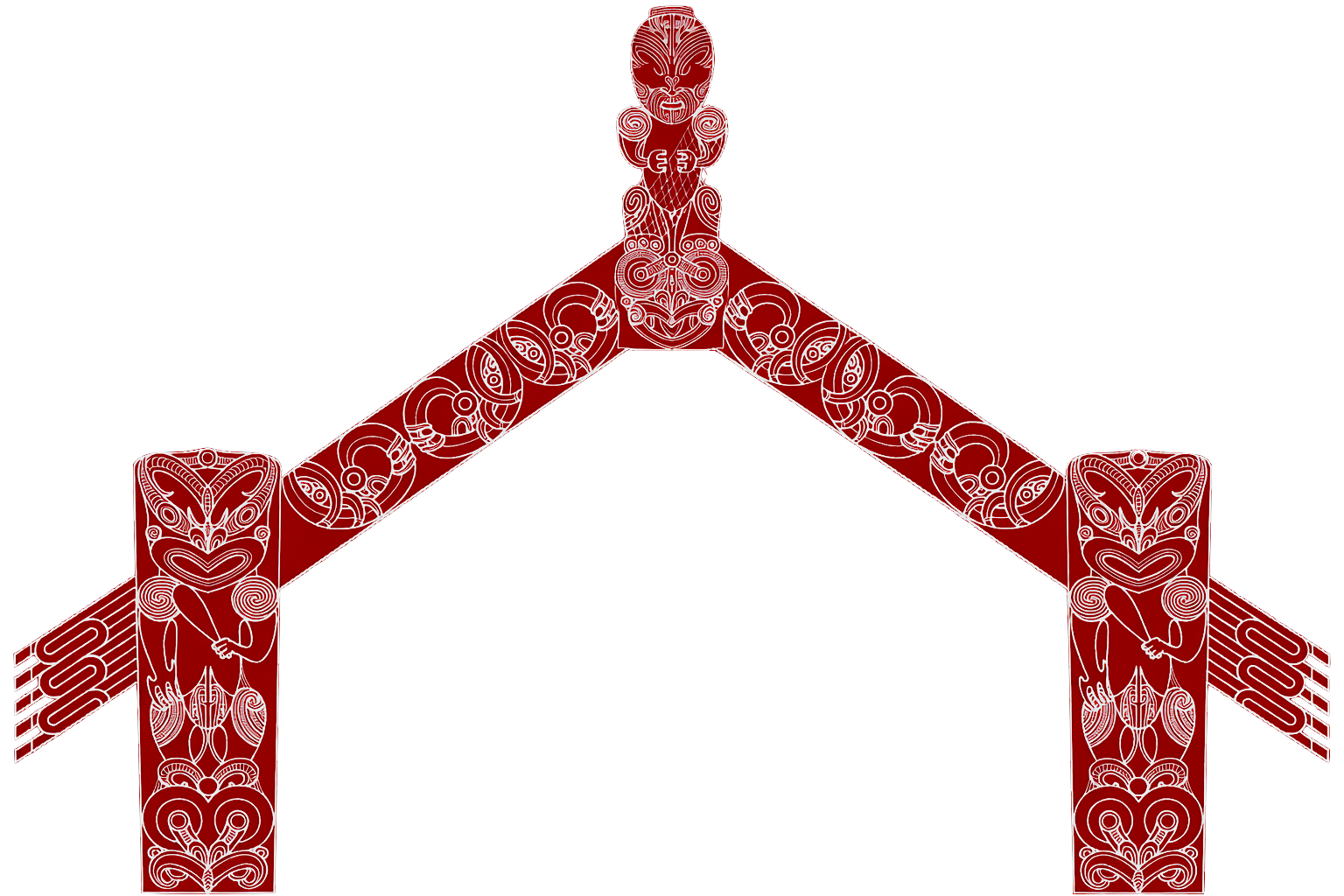
This whare tupuna design depicts Te Manuhauturuki at the apex of Tangaroa’s whare, Hui-te-ana-nui.
Tangaroa created the first whare tupuna (carved ancestral house), which stood at the bottom of the ocean. The house was named Hui-te-ana-nui, and it was a gathering place for all fish species. All of the poupou (carved figures) on the inside of the whare could speak and sing, but those on the outside could not.
The oldest son of Ruatepupuke, named Te Manuhauturuki, had taken his net out fishing without offering respect to Tangaroa through karakia, which offended Tangaroa. He pulled Te Manuhauturuki down to the bottom of the ocean, and fixed him at the apex of Hui-te-ana-nui, thereby turning him into the first ever tekoteko (carved figure).
Ruatepupuke set out to rescue him, and dived into the depths of the ocean. He set fire to the whare and as the fish (the children of Tangaroa) darted out to escape the flames, many getting burned in the process. Ruatepupuke stood at the entrance of the whare and struck at them, leaving them disfigured and reshaped – hence why the stingray, the flounder, the hammerhead shark and the octopus all look so unique. The scars and burns they suffered reflect why the fish species have so many different colours and patterns.
Ruatepupuke freed Te Manuhauturuki, and as part of the utu, he took with him several poupou from the front of Tangaroa’s whare. This is the origin of the art of whakairo – and is why our carved images today do not possess the power of speech.
Today Māori carvings instead tell their stories in the adornment of surface design and tribal styles, allowing man to communicate whakapapa (genealogy) as well as issues of morality, values, sacredness and wisdom.

Carving set in resin by Lewis Gardiner of Rakai Jade Ltd.
This carving was designed and created for Te Whare Hukahuka in 2015.
It depicts te tau ihu o te waka (the prow of a canoe) navigating boldly through the unknown waters of change, reflecting a whakataukī that we staunchly hold firm to by Dr Apirana Mahuika –“E tū ki te kei o te waka, kia pakia koe e ngā ngaru o te wā.”
(Stand at the stern of the canoe, and feel the spray of the future biting at your face).
The carving is purple to reflect the story, ‘The Purple Cow’, by Seth Godin, which refers to being the purple cow in a field of monochrome heifers. It reminds us of being so distinctive amongst the crowd that you are remarkable.
The carving is adorned with paua and white insets to reflect the domain of the sea and the sea foam from where our name “Te Whare Hukahuka” derives.